
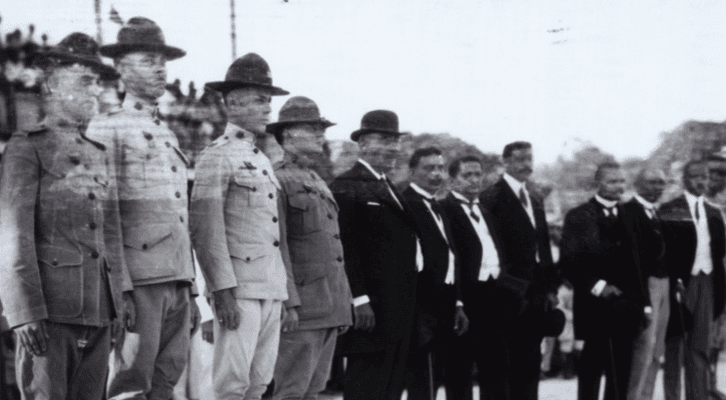

When they say Haiti is open for business, do know that these are not the words of self-reflecting statesmen, but the words of possessed men.
There is, in Haiti, a particular ghost that has been haunting the people of the nation for 100 years. It haunts not only their persons, but their politics, their very livelihood. It is a peculiar ghost, for it is not the ghost of one person but of many. It is even the ghost of non-persons, of ideas, of places, of things said and things wished.
It is in the ominous year of 1915 that we begin tracing the historical roots of this ghost that haunts Haiti. That year, the people of Haiti learned that they were to be the subjects of an American occupation and it was for their own good. They were to be ruled now by Admiral Caperton, a white man. This did not sit well with them for they were a black nation and they had driven off the white man along with their slavery 100 years before. But the Admiral was not like the other white men they had heard of: he put aside the customs of segregation that were the norm in his country. He was jovial in the taking of companionship with those black men in Haiti.
Caperton wore a thick mustache, they said. He was polite and was quite the dancer. On the occasions where he would go to their homes for dinner, he never passed up the opportunity to dance with their wives, his white hands wrapped tight around their black palms and their black bodies ever pressing against the dress uniforms he wore for such moments. Through these dinners and dances, he charmed them with assurances that the United States were in Haiti to do good, to guide the country forward. Many believed him, and they looked forward to a peaceful and prosperous Haiti. The Admiral did not forget about Haiti’s poor. He sent out one of his subordinates, one Arthur Miller, with a Haitian interpreter at his side, to communicate with the peasants of the countryside. He promised the peasants many things: that America was here to eliminate poverty, and to protect them from the tyranny of their governments. In the midst of all of this, there was of course resistance, for there were those who did not believe. But those who resisted were imprisoned and clobbered to their deaths. They faced the wrath of Smedley Butler who believed that Haiti was to do well as long as white men lead them.
By the end of August, Admiral Caperton was the sole king of Haiti. He had seized the National Bank of Haiti, and had taken control of all the major customs houses on the island. He appointed a president, Surdre Dartiguenave, who was to be the voice and face of the Occupation. Dartiguenave sang the tunes of Caperton and helped disseminate the propaganda that America was here to alleviate the struggles of a people who had struggled for too long.
But Admiral William B. Caperton, with his thick mustache, charm, and good dancing skills was only the faithful executioner of a process. He had been acting on the orders of Robert Lansing and the State Department, who in turn had been receiving guidance from American businessmen like Roger Farnham and Paul Allen who were part of a larger collective of Wall Street men. These Wall Street men, according to historian Georges Eddy Lucien, held the larger share of a 600 billion dollar capital seated idly in the banks of the United States, France, England and Germany. It was necessary for them to have that money grow and so they needed new territories, they needed occupations.
Professor Laurent DuBois tells us that it was these same Wall Street men that the State Department relied on when it decided to strip away Haiti’s constitutional amendment that barred land ownership to foreigners. The stripping of this constitutional amendment opened Haiti up for business, and the businesses came in like swarming bees. They came singing the tunes of the Admiral, promising millions of dollars in investments, in job creation and economic uplift. Some of these companies we can name: The Haitian-American Sugar Company, The National Citi Bank of New York, the Haitian-American Pineapple Company, Dyewood of Boston. Thousands of peasants lost their lands, lands owned by them for generations; they now had to work for big foreign corporations for meager wages.
By 1922, Haiti was a different country. Its old army had been completely eliminated and was replaced by the Gendarmerie, a native force created by the bloodthirsty Smedley Butler who won a medal in Haiti for his bloodthirstiness. The Gendarmerie was to maintain peace and security in the country. It achieved this through forced labor (for a new infrastructure needed to be built for all the promises of these new corporations), imprisonment and torture and lots and lots of killings. When segregationist John H. Russell was appointed High Commissioner of Haiti that year, he oversaw an ambitious project of nation building: he was going to create a middle class, he was tired of Haitians and their education of poetry and literature, and of medicine and of law. Occupation was now going to teach Haitians how to farm, how to build furniture. This was going to move the country forward.
The Occupation ends in 1934. Many of the men who masterminded it, Caperton, Butler, and their puppets, Dartiguenave, had all but died. The corporations that were given lands failed miserably, with the lone exception of the Haitian-American Sugar Company: it closed its doors in 1989. The people were now landless and jobless. So immigration became a necessity. But these dead men, these dead entities, they live on as one collective in this ghost that continues to mold Haiti’s policy.
When President Michel Martelly and his ministers announce that the nation is open for business, do know that these are not the words of self-reflecting statesmen, but the words of possessed men. When you hear numerous casual observers and passionate advocates of Haiti alike insist that Haiti needs more investments from abroad to move forward, know that these feelings are not rooted in conviction but are rather the self-serving propaganda of dead men who can’t figure how to remain rotten in their crypt with their defunct corporations.
When you read about the ten thousand NGO’s in Haiti bragging about the purposefulness of their presence there, about how they’re helping the poor and the unfortunate, be mindful that such bragging is but the reverberating echo of John H. Russell and the Service Technique. Not even Stephanie Villedrouin, the young and current Minister of Tourism for Haiti, has not had the good fortunes of escaping the haunts of this spirit. She has been stubborn in her tenacity to hand over L’ile-A-Vache to persons and non-persons who and which we do not know. But their promises and tactics, we are familiar with. They are promises of job growth, economic uplift and middle class creation and that means citizens must vacate their lands for the materialization of these promises in the same way their ancestors did for The National Railway of Haiti, the Haitian-American Sugar Company or the Haitian-American Pineapple Company 100 years ago.
At this point, we can only hope to one day get a class of politicians who are well trained in the matters of the paranormal, so they may finally cast out this ghost of 100 years that continues to get in the way of Haiti’s progress.
Please support Alain Martin's documentary on the U.S. occupation of Haiti "The Forgotten Occupation" on Kickstarter.





" height="102.5816409423233px" id="g2kZUfxvI" width="102.91800162469531px"/></svg>)
" height="103px" id="oG538LvCh" width="102.99817255782794px"/></svg>)
" height="103px" id="SKAc1JCfN" transform="translate(1.11 0)" width="100.78524425744274px"/></svg>)