Search

Read in kreyòl

Kreyòl

Menu

Kreyòl

Menu

In Conversation

In Conversation

In Conversation

“Chèche lavi lòt bò dlo”: An Interview with Haitian Singer Jean Belony “BélO” Murat on Migration and Healing
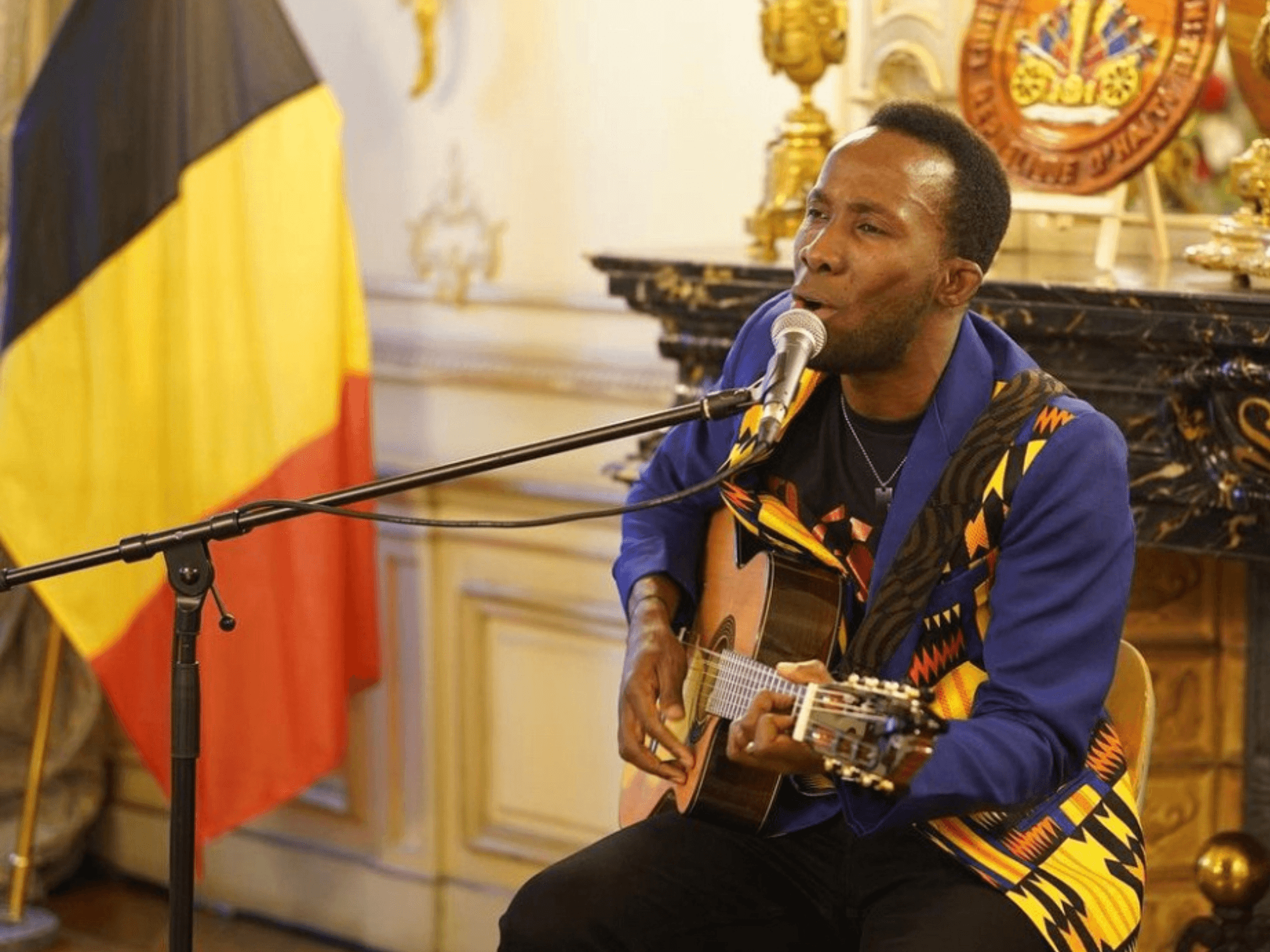
To be honest with you, I really think that if it wasn’t for Haiti, I wouldn’t be an artist.

BélO

In 2021, Haiti experienced a series of traumatic events including the assassination of the President Jovenel Moïse, another devastating earthquake of 7.1 magnitude, and the arrival of 15,000 Haitian asylum seekers at the Del Rio, Texas border.

In the midst of recurring trauma, there is a need for Haitians to recalibrate to have deeper conversations about healing. Jean Belony “BélO” Murat is a socially conscious Haitian artist and musical ambassador who uses his distinctive traditional sound to share messages of collective healing and community building.

In this interview, BélO discusses his view of “chèche lavi lòt bò dlo” (looking for a better life abroad) through his work. As a Haitian ambassador, BélO’s objective is to use his music to share Haitian experiences, traditions and culture at home and abroad.

Be sure to check out his latest project, a recreation of his very first album "Lakou Trankil" — which came out 18 years ago now — reimagined with the help of female artists the likes of Wiliadel Denervil, Queen Bee, and Sherlee Skai, who reinterpreted the tracks on the original album to make a compilation of covers called "Fanm Lakou Trankil".

He spoke to Ashley E. Lazarre, PhD Candidate of Global Inclusion and Social Development at the University of Massachusetts Boston. 

Song: Intro Kote Moun Yo by BélO

AEL: In a previous interview, you mentioned that your inspiration always comes from Haiti. Your album “Natif Natal” (of native origin) personifies Haiti as your native roots. Even when you explore other genres, such as Afrobeats with Adekunle Gold or Electronic Music with Michael Brun (which can be considered outside of your norm), no matter what beat you are on when I hear your voice I know this is BélO. Why is it important to you that your inspiration comes from Haiti?

JBM: To be honest with you, I really think that if it wasn’t for Haiti, I wouldn’t be an artist. To me, it is very important for Haiti to be at the center of my music —it is not even a choice— that’s the way it is meant to be.

I did not plan for it to be this way but my mission is to take a socially-conscious approach to my work because Haiti has very specific needs.

It’s been over 200 years since we've been fighting a difficult battle dating back to our independence, including addressing environmental problems and political disasters.

Even if everyone is partying, I have to go to sleep so that I can dream and receive the remedy for the sickness in my country — “Si m pa dòmi mwen p ap fè rèv la” (If I don’t sleep, I won’t have the dream).

The privilege that usually comes with being an artist such as having big cars and luxury, none of that is fit for me.

AEL: In music you talk about an overemphasis on Haiti’s trauma by mainstream media, which can also be reproduced in academia. You challenge these narratives by singing about the importance of HIV screenings, knowing your roots, preserving your culture, farming, and mental health. Why is healing a critical message in your music?

JBM: Because there is a need for healing. The media looks for news that the world is more interested in – that is their role. But what is our role as Haitian people?

If people are trying to demonize you, do you try to put yourself in a better position every day?

I think this is where we should focus our efforts. I also have to be realistic about the current state of our country, but are there a lot of Haitians who focus on promoting good things about our country? Are we proud enough about our Vodou? Do we let people know what it is? Or do we just let Hollywood show one side of it?

That’s why when I am touring, I always wear something Haitian. I always put our traditions to the forefront so that everyone knows that this is traditional Haitian wear, it is from Vodou, it is from Haiti. I want to show the sides of Haiti that people have never seen before. 

We also need more people to bring value to our language. There are many people who have told me that I would be further along in my career as a musician if I sang in languages other than Kreyòl. I always respond by saying “I have gotten quite far using my language”.

If more Haitians created more things in Kreyòl perhaps it would have been a more popular language than it is now. We should not adapt to everything being in English and follow suit because we miss out on our culture and identity. 

“Nou se Wozo, nou pliye nou paka kase”.

Song: Wozo by BélO

AEL: "Wozo" is my favorite song. It inspired me in times where I didn’t really see the light in my work, where it was going or what I wanted to do. The song reminded me of why I am here, specifically that I am Haitian and that there is a deeper sense of resilience in me. I often use “Wozo” as a concept in my research when talking about Haitians and who we are as a people. You released this song after the 2010 earthquake as a reminder to Haitians to uplift themselves. Can you talk about the roots of the Kreyòl term "wozo"? 

JBM: "Wozo" means bamboo tree. A bamboo tree is a plant that you can bend, but it is really hard to break it.

The day after the earthquake in 2010, I was in Guadeloupe when I received the news that “there are no more Haitians left in Haiti”. That’s the way the news was presented to me.

They said it was over for Haiti and that there was no one left standing in the country. I was shocked but I thought “these images and videos are coming from Haiti, so there is at least one Haitian alive.” And knowing my people, if there is at least one man and one woman in Haiti, that’s enough for us to come back to life.

I said to myself  “nou se Wozo, nou pliye nou paka kase” (we are wozo, we bend but we cannot break).

Song: Istwa Dwòl by BélO

AEL: Let’s talk about the concept of “chache lavi lòt bò dlo” (looking for a better life abroad). I think this resonates for me personally, as I have had to step back from going to Haiti frequently due to recent social issues. There is a distance that’s been created between me and home, where I had to find home wherever I am. How do you think the experience of “cheche lavi lòt bò dlo” relates to a search for healing?

JBM:Al chèche lavi” does not mean going to look for a plate of food. From a Haitian context, a peasant who sends their children to the city to get a better education is looking to “chèche lavi” (look for a better life) for their children. They are aware of the limitations and obstacles that come with being illiterate, so their goal is to provide more for their children.

Haitians fight to give their children a better life so that they don’t have to go through the same obstacles as they have. This also applies to middle class Haitians. Parents send their kids abroad to look for a better life not because they need better food and housing but because there is a bigger vision to fund their future to become doctors, athletes, engineers, or artists.

They go to the U.S. because that is where they can get a better education with resources to learn. “Al chèche lavi” for me means being proactive about looking for a better future. 

AEL: In the video “Istwa Dwòl”, there is a scene of 5 men taking a small boat to leave the country while their families worry about their whereabouts and the potential risks along the journey. This video which was shot more than 15 years ago foreshadows the actual scenes we saw involving the 15,000 Haitian asylum seekers who walked from South America to the Del Rio, Texas border. Why did you choose to show scenes of Haitians escaping home in the video?

JBM: I chose to show these visuals because as the saying goes, "a picture is worth a thousand words". It was important for me to show Haitians that there are some problems that we cannot control but that there are things within our reach. We should focus our energy on the circumstances that we can control. 

The song itself sheds light on the fact that if peasants are leaving, artists are leaving, and doctors are leaving, it is because there is a central problem in our country.

Who will they kidnap when everyone leaves? Or will we rethink our stance to convince each other to stop the self-inflicted violence so we can all be home together again.

With solidarity we can resist being brainwashed and save our country. We know that we are “Wozo” (resilient) and we can get back up, but it is much harder to get back up by yourself than if someone gives you a hand.

Haitians can’t consider each other to be a problem because there are many other external factors that we have to deal with. 

Haiti is our mother and no matter where we are in the world, we will never be considered Haiti’s stepchild. 

Song: Pitit Deyò by BélO

AEL: In the song, you also elaborate on the relationship of the diaspora with Haiti. What does it mean to be a “pitit deyò”?

JBM: I named the song “Pitit Deyò” (stepchild) because in literal terms when a father births a child outside of wedlock we call this child the “stepchild”. But when a mother births a child outside of her marriage, that kid remains her biological child no matter what. Every mother’s child is considered biological.

In that sense, Haiti is our mother and no matter where we are in the world, we will never be considered Haiti’s stepchild. 

With that, the song speaks to improving our relationship with the diaspora. I felt this fear coming from them so that's why I wrote the song.

We cannot just expect the diaspora to send us money via Western Union and nice sneakers every month. We need a relationship that is more inclusive.

AEL: Anthropologist Gina A. Ulysse, speaks about the need for “rasanblaj” – “the need for deeper, thoughtful, and self-reflective conversations among Haitians”. She notes that “living in fragmentation has been our way” and she urges Haitians to take pause to recalibrate. How do you recalibrate in times of crisis, personally and as an artist?

JBM: I would say personally it is a hard thing to do. For the past two years, I’ve been more active on social media, not just to share my art but to share a little message of hope because I know when you are in crisis it is hard to think outside of the box. But as an artist, sometimes I travel or my soul leaves my body and goes to get inspiration elsewhere, not just for me, but to share with other people because to me that’s what an artist is. 

AEL: A great note to end our conversation on. Thank you so much for sharing your thoughts on "chèche lavi lòt bò dlo". 

“Chèche lavi lòt bò dlo”: An Interview with Haitian Singer Jean Belony “BélO” Murat on Migration and Healing

To be honest with you, I really think that if it wasn’t for Haiti, I wouldn’t be an artist.

BélO

In 2021, Haiti experienced a series of traumatic events including the assassination of the President Jovenel Moïse, another devastating earthquake of 7.1 magnitude, and the arrival of 15,000 Haitian asylum seekers at the Del Rio, Texas border.

In the midst of recurring trauma, there is a need for Haitians to recalibrate to have deeper conversations about healing. Jean Belony “BélO” Murat is a socially conscious Haitian artist and musical ambassador who uses his distinctive traditional sound to share messages of collective healing and community building.

In this interview, BélO discusses his view of “chèche lavi lòt bò dlo” (looking for a better life abroad) through his work. As a Haitian ambassador, BélO’s objective is to use his music to share Haitian experiences, traditions and culture at home and abroad.

Be sure to check out his latest project, a recreation of his very first album "Lakou Trankil" — which came out 18 years ago now — reimagined with the help of female artists the likes of Wiliadel Denervil, Queen Bee, and Sherlee Skai, who reinterpreted the tracks on the original album to make a compilation of covers called "Fanm Lakou Trankil".

He spoke to Ashley E. Lazarre, PhD Candidate of Global Inclusion and Social Development at the University of Massachusetts Boston. 

Song: Intro Kote Moun Yo by BélO

AEL: In a previous interview, you mentioned that your inspiration always comes from Haiti. Your album “Natif Natal” (of native origin) personifies Haiti as your native roots. Even when you explore other genres, such as Afrobeats with Adekunle Gold or Electronic Music with Michael Brun (which can be considered outside of your norm), no matter what beat you are on when I hear your voice I know this is BélO. Why is it important to you that your inspiration comes from Haiti?

JBM: To be honest with you, I really think that if it wasn’t for Haiti, I wouldn’t be an artist. To me, it is very important for Haiti to be at the center of my music —it is not even a choice— that’s the way it is meant to be.

I did not plan for it to be this way but my mission is to take a socially-conscious approach to my work because Haiti has very specific needs.

It’s been over 200 years since we've been fighting a difficult battle dating back to our independence, including addressing environmental problems and political disasters.

Even if everyone is partying, I have to go to sleep so that I can dream and receive the remedy for the sickness in my country — “Si m pa dòmi mwen p ap fè rèv la” (If I don’t sleep, I won’t have the dream).

The privilege that usually comes with being an artist such as having big cars and luxury, none of that is fit for me.

AEL: In music you talk about an overemphasis on Haiti’s trauma by mainstream media, which can also be reproduced in academia. You challenge these narratives by singing about the importance of HIV screenings, knowing your roots, preserving your culture, farming, and mental health. Why is healing a critical message in your music?

JBM: Because there is a need for healing. The media looks for news that the world is more interested in – that is their role. But what is our role as Haitian people?

If people are trying to demonize you, do you try to put yourself in a better position every day?

I think this is where we should focus our efforts. I also have to be realistic about the current state of our country, but are there a lot of Haitians who focus on promoting good things about our country? Are we proud enough about our Vodou? Do we let people know what it is? Or do we just let Hollywood show one side of it?

That’s why when I am touring, I always wear something Haitian. I always put our traditions to the forefront so that everyone knows that this is traditional Haitian wear, it is from Vodou, it is from Haiti. I want to show the sides of Haiti that people have never seen before. 

We also need more people to bring value to our language. There are many people who have told me that I would be further along in my career as a musician if I sang in languages other than Kreyòl. I always respond by saying “I have gotten quite far using my language”.

If more Haitians created more things in Kreyòl perhaps it would have been a more popular language than it is now. We should not adapt to everything being in English and follow suit because we miss out on our culture and identity. 

“Nou se Wozo, nou pliye nou paka kase”.

Song: Wozo by BélO

AEL: "Wozo" is my favorite song. It inspired me in times where I didn’t really see the light in my work, where it was going or what I wanted to do. The song reminded me of why I am here, specifically that I am Haitian and that there is a deeper sense of resilience in me. I often use “Wozo” as a concept in my research when talking about Haitians and who we are as a people. You released this song after the 2010 earthquake as a reminder to Haitians to uplift themselves. Can you talk about the roots of the Kreyòl term "wozo"? 

JBM: "Wozo" means bamboo tree. A bamboo tree is a plant that you can bend, but it is really hard to break it.

The day after the earthquake in 2010, I was in Guadeloupe when I received the news that “there are no more Haitians left in Haiti”. That’s the way the news was presented to me.

They said it was over for Haiti and that there was no one left standing in the country. I was shocked but I thought “these images and videos are coming from Haiti, so there is at least one Haitian alive.” And knowing my people, if there is at least one man and one woman in Haiti, that’s enough for us to come back to life.

I said to myself  “nou se Wozo, nou pliye nou paka kase” (we are wozo, we bend but we cannot break).

Song: Istwa Dwòl by BélO

AEL: Let’s talk about the concept of “chache lavi lòt bò dlo” (looking for a better life abroad). I think this resonates for me personally, as I have had to step back from going to Haiti frequently due to recent social issues. There is a distance that’s been created between me and home, where I had to find home wherever I am. How do you think the experience of “cheche lavi lòt bò dlo” relates to a search for healing?

JBM:Al chèche lavi” does not mean going to look for a plate of food. From a Haitian context, a peasant who sends their children to the city to get a better education is looking to “chèche lavi” (look for a better life) for their children. They are aware of the limitations and obstacles that come with being illiterate, so their goal is to provide more for their children.

Haitians fight to give their children a better life so that they don’t have to go through the same obstacles as they have. This also applies to middle class Haitians. Parents send their kids abroad to look for a better life not because they need better food and housing but because there is a bigger vision to fund their future to become doctors, athletes, engineers, or artists.

They go to the U.S. because that is where they can get a better education with resources to learn. “Al chèche lavi” for me means being proactive about looking for a better future. 

AEL: In the video “Istwa Dwòl”, there is a scene of 5 men taking a small boat to leave the country while their families worry about their whereabouts and the potential risks along the journey. This video which was shot more than 15 years ago foreshadows the actual scenes we saw involving the 15,000 Haitian asylum seekers who walked from South America to the Del Rio, Texas border. Why did you choose to show scenes of Haitians escaping home in the video?

JBM: I chose to show these visuals because as the saying goes, "a picture is worth a thousand words". It was important for me to show Haitians that there are some problems that we cannot control but that there are things within our reach. We should focus our energy on the circumstances that we can control. 

The song itself sheds light on the fact that if peasants are leaving, artists are leaving, and doctors are leaving, it is because there is a central problem in our country.

Who will they kidnap when everyone leaves? Or will we rethink our stance to convince each other to stop the self-inflicted violence so we can all be home together again.

With solidarity we can resist being brainwashed and save our country. We know that we are “Wozo” (resilient) and we can get back up, but it is much harder to get back up by yourself than if someone gives you a hand.

Haitians can’t consider each other to be a problem because there are many other external factors that we have to deal with. 

Haiti is our mother and no matter where we are in the world, we will never be considered Haiti’s stepchild. 

Song: Pitit Deyò by BélO

AEL: In the song, you also elaborate on the relationship of the diaspora with Haiti. What does it mean to be a “pitit deyò”?

JBM: I named the song “Pitit Deyò” (stepchild) because in literal terms when a father births a child outside of wedlock we call this child the “stepchild”. But when a mother births a child outside of her marriage, that kid remains her biological child no matter what. Every mother’s child is considered biological.

In that sense, Haiti is our mother and no matter where we are in the world, we will never be considered Haiti’s stepchild. 

With that, the song speaks to improving our relationship with the diaspora. I felt this fear coming from them so that's why I wrote the song.

We cannot just expect the diaspora to send us money via Western Union and nice sneakers every month. We need a relationship that is more inclusive.

AEL: Anthropologist Gina A. Ulysse, speaks about the need for “rasanblaj” – “the need for deeper, thoughtful, and self-reflective conversations among Haitians”. She notes that “living in fragmentation has been our way” and she urges Haitians to take pause to recalibrate. How do you recalibrate in times of crisis, personally and as an artist?

JBM: I would say personally it is a hard thing to do. For the past two years, I’ve been more active on social media, not just to share my art but to share a little message of hope because I know when you are in crisis it is hard to think outside of the box. But as an artist, sometimes I travel or my soul leaves my body and goes to get inspiration elsewhere, not just for me, but to share with other people because to me that’s what an artist is. 

AEL: A great note to end our conversation on. Thank you so much for sharing your thoughts on "chèche lavi lòt bò dlo". 

"Creativity is our Oxygen," an interview with Charline Jean-Gilles

The situation of the country cannot prevent us from creating. We must continue to create, because it is from creativity that we live. Creativity is our oxygen. Ayibobo.

CHARLINE JEAN GILLES

"Creativity is our Oxygen," an interview with Charline Jean-Gilles

The situation of the country cannot prevent us from creating. We must continue to create, because it is from creativity that we live. Creativity is our oxygen. Ayibobo.

CHARLINE JEAN GILLES

Writing to Fill the Void: An Interview With Haitian Playwright Andrise Pierre
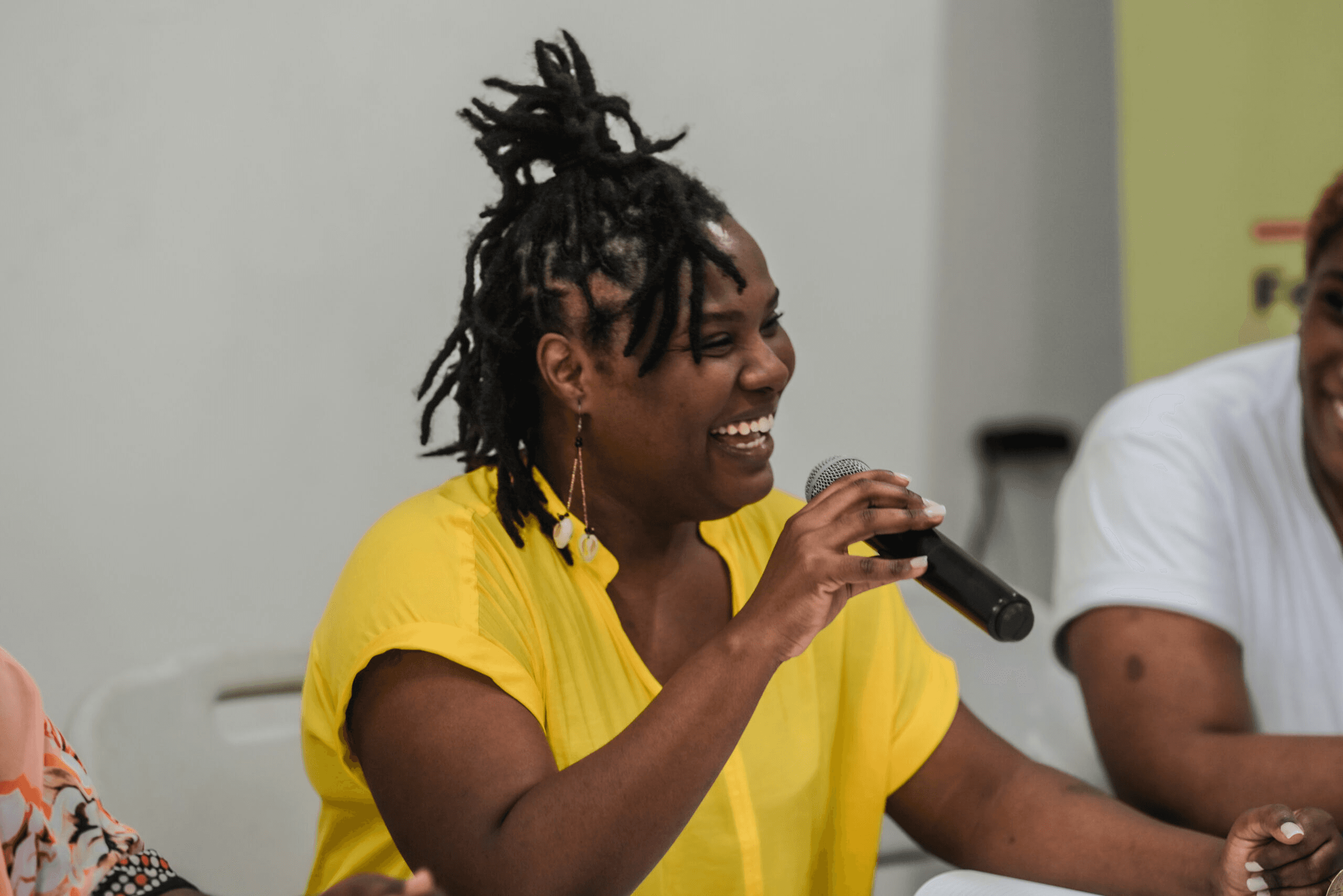
I'm a young author born in a country where you can count on your fingers how many theatres there are

ANDRISE PIERRE

Writing to Fill the Void: An Interview With Haitian Playwright Andrise Pierre

I'm a young author born in a country where you can count on your fingers how many theatres there are

ANDRISE PIERRE

An interview with Alain Martin, director of "The Forgotten Occupation"
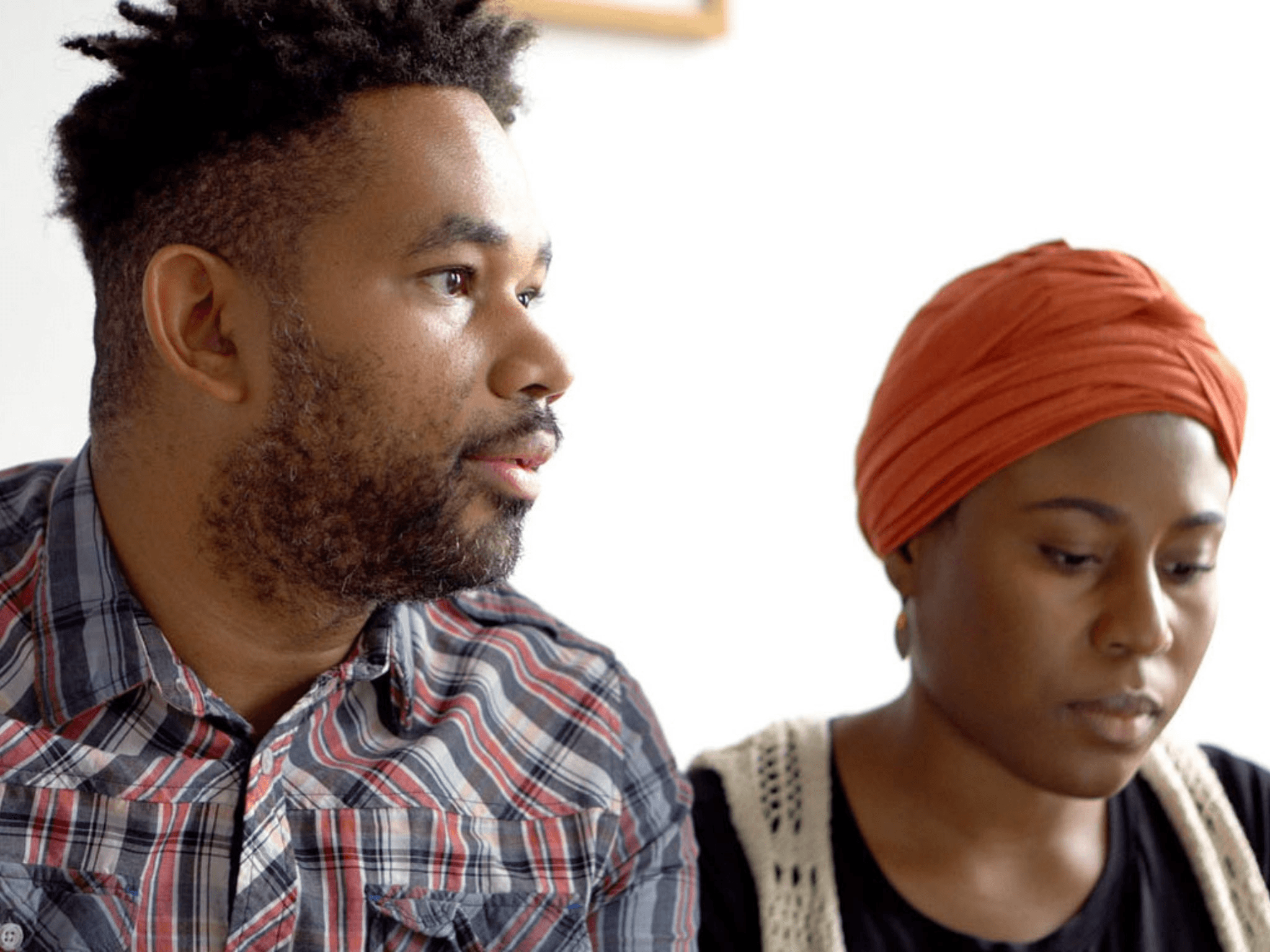
The Occupation of Afghanistan lasted two decades, one year longer than our own intervention. Is Afghanistan better off today?  Puerto Rico is a territory of the US. Are they better off?

ALAIN MARTIN

Alain Martin's much anticipated documentary The Forgotten Occupation exploring the history surrounding the American occupation of Haiti in 1915 has finally released its official trailer. We sat down with Martin to learn more about this endeavor, his team, what he hopes we can take away from this work and more. We had the opportunity to chat with him on the matter for our podcast back in 2018. Have a listen here.

We are so excited to finally view the trailer of this ongoing project! This movie has been long in the making, what major lessons have  you learned along the way? 

Artistic capital is just as significant as financial capital. I remember after we raised our 25k through Kickstarter, we were all elated thinking we had this in the bag. But after the first edit, the movie sucked and we eventually realized it was lacking in soul, in artistic direction. It took us another five years to figure out what we wanted to say and why.  

So I will say that one of the lessons learned here, when it comes to making a film, is to know what you have to say, why you want to say it and how you want to say it is quite significant. Second, irrespective of how historical a documentary is, films are made to entertain,  to engender connections with the audience. As problematic as this may sound, connecting and moving the audience is more important than the facts of your film. 

Lastly, the cavalry is not coming, you are the cavalry you seek. We kept waiting for some magical person to come around, we thought we had raised enough money for that magical person. But in the end, such person never showed up and we rescued the project ourselves. So in life, the best person to know is yourself. 

Tell us about the team that has made this film possible. 

Hans Augustave has really really been indispensable in the making of this film. He had a job with a production company in the city and that allowed us access to free equipment to shoot all the stuff we needed. This film as it is now ain’t possible without him. 

James Doran who I enlisted as an artist consultant ended up shooting the last third of production for free. His involvement really elevated the work. 

I have to also give a shout out to Professor Patrick Bellegarde Smith who nudged in the right direction in terms of which books to read and who to interview. Some of those interviews did wonders for the film. 

Intervention in Haiti is again being debated in the public sphere. How does your film contribute to that conversation?

That’s such an interesting question. In the intervening years before the occupation, Haiti, as a lot of people saw it then, was quite in a deplorable state, not unlike today. In an interview, the historian Roger Gaillard gave to Jean Dominique back in the 1960’s, he describes the sullen psyche of the young Haitians at the time. They were tired of the social-political conditions of their country. It had been liberated for an entire century and yet had nothing to show for it. In the three years before the US Occupation, Haiti had seven different presidents. So talk of a US Occupation was welcomed, for they saw it as the only way out. And honestly, they can be forgiven for this. We have to remember these were the days of the ascension of the American Empire. Immigrants were flocking to it by the millions. Stories of poor people becoming rich overnight in America abounded. 

Furthermore, this was also the beginning of a 20th century that was washing the world with so much technological marvel. The radio. The telephone. Film. The airplane. The automobile. And the United States was at the forefront of all that. So these young despairing Haitians desperately thought an American Occupation would grant them entrance into the modern world of the 20th century. They were of course mistaken. And it is the same today, Haiti is in such a deplorable state that many people are openly asking for American intervention. But they have, as examples, the previous interventions in Haiti, the intervention in Iraq. The Occupation of Afghanistan lasted two decades, one year longer than our own intervention. Is Afghanistan better off today?  Puerto Rico is a territory of the US. Are they better off? So our film contributes to this conversation by evincing this forgotten past of ours. It reminds us that history itself does not move along a linear process but rather through a cyclical one. Things happen. And then they happen again with new actors, over and over. 


Check out the official trailer for "The Forgotten Occupation"

What do you hope this film will offer to a younger generation of Haitians inside of Haiti and outside of it?

That’s such a tough question to answer. I don’t know if I’m arrogant enough to assume that our film offers anything to anyone. But I will hope that the film itself lessens our historical amnesia, awakens us to this idea that we can only be rescued by some benevolent force outside ourselves. I also hope the film broadens their perception around Haitian immigration and why it’s happening and not to fall victim to the usual and incomplete narratives about how Haiti has arrived to the place it’s at now. 

What’s next for you and your team? 

I know Hans, the producer, is raising funds for his film NWA and I’m quite excited about that. I had a slight hand in the direction of the story. 

Me and James are in the process of shooting a feature, an anthology about Queens that is 25 percent complete. It’s an Homage to Queens and its immigrant communities. Queens is the most diverse place in the entire world. More languages are spoken in Queens than anywhere else in the world. I grew up in Queens, so did James so we thought it’s an interesting project to make.

Feature photo credit: The Forgotten Occupation

An interview with Alain Martin, director of "The Forgotten Occupation"

The Occupation of Afghanistan lasted two decades, one year longer than our own intervention. Is Afghanistan better off today?  Puerto Rico is a territory of the US. Are they better off?

ALAIN MARTIN

Alain Martin's much anticipated documentary The Forgotten Occupation exploring the history surrounding the American occupation of Haiti in 1915 has finally released its official trailer. We sat down with Martin to learn more about this endeavor, his team, what he hopes we can take away from this work and more. We had the opportunity to chat with him on the matter for our podcast back in 2018. Have a listen here.

We are so excited to finally view the trailer of this ongoing project! This movie has been long in the making, what major lessons have  you learned along the way? 

Artistic capital is just as significant as financial capital. I remember after we raised our 25k through Kickstarter, we were all elated thinking we had this in the bag. But after the first edit, the movie sucked and we eventually realized it was lacking in soul, in artistic direction. It took us another five years to figure out what we wanted to say and why.  

So I will say that one of the lessons learned here, when it comes to making a film, is to know what you have to say, why you want to say it and how you want to say it is quite significant. Second, irrespective of how historical a documentary is, films are made to entertain,  to engender connections with the audience. As problematic as this may sound, connecting and moving the audience is more important than the facts of your film. 

Lastly, the cavalry is not coming, you are the cavalry you seek. We kept waiting for some magical person to come around, we thought we had raised enough money for that magical person. But in the end, such person never showed up and we rescued the project ourselves. So in life, the best person to know is yourself. 

Tell us about the team that has made this film possible. 

Hans Augustave has really really been indispensable in the making of this film. He had a job with a production company in the city and that allowed us access to free equipment to shoot all the stuff we needed. This film as it is now ain’t possible without him. 

James Doran who I enlisted as an artist consultant ended up shooting the last third of production for free. His involvement really elevated the work. 

I have to also give a shout out to Professor Patrick Bellegarde Smith who nudged in the right direction in terms of which books to read and who to interview. Some of those interviews did wonders for the film. 

Intervention in Haiti is again being debated in the public sphere. How does your film contribute to that conversation?

That’s such an interesting question. In the intervening years before the occupation, Haiti, as a lot of people saw it then, was quite in a deplorable state, not unlike today. In an interview, the historian Roger Gaillard gave to Jean Dominique back in the 1960’s, he describes the sullen psyche of the young Haitians at the time. They were tired of the social-political conditions of their country. It had been liberated for an entire century and yet had nothing to show for it. In the three years before the US Occupation, Haiti had seven different presidents. So talk of a US Occupation was welcomed, for they saw it as the only way out. And honestly, they can be forgiven for this. We have to remember these were the days of the ascension of the American Empire. Immigrants were flocking to it by the millions. Stories of poor people becoming rich overnight in America abounded. 

Furthermore, this was also the beginning of a 20th century that was washing the world with so much technological marvel. The radio. The telephone. Film. The airplane. The automobile. And the United States was at the forefront of all that. So these young despairing Haitians desperately thought an American Occupation would grant them entrance into the modern world of the 20th century. They were of course mistaken. And it is the same today, Haiti is in such a deplorable state that many people are openly asking for American intervention. But they have, as examples, the previous interventions in Haiti, the intervention in Iraq. The Occupation of Afghanistan lasted two decades, one year longer than our own intervention. Is Afghanistan better off today?  Puerto Rico is a territory of the US. Are they better off? So our film contributes to this conversation by evincing this forgotten past of ours. It reminds us that history itself does not move along a linear process but rather through a cyclical one. Things happen. And then they happen again with new actors, over and over. 


Check out the official trailer for "The Forgotten Occupation"

What do you hope this film will offer to a younger generation of Haitians inside of Haiti and outside of it?

That’s such a tough question to answer. I don’t know if I’m arrogant enough to assume that our film offers anything to anyone. But I will hope that the film itself lessens our historical amnesia, awakens us to this idea that we can only be rescued by some benevolent force outside ourselves. I also hope the film broadens their perception around Haitian immigration and why it’s happening and not to fall victim to the usual and incomplete narratives about how Haiti has arrived to the place it’s at now. 

What’s next for you and your team? 

I know Hans, the producer, is raising funds for his film NWA and I’m quite excited about that. I had a slight hand in the direction of the story. 

Me and James are in the process of shooting a feature, an anthology about Queens that is 25 percent complete. It’s an Homage to Queens and its immigrant communities. Queens is the most diverse place in the entire world. More languages are spoken in Queens than anywhere else in the world. I grew up in Queens, so did James so we thought it’s an interesting project to make.

Feature photo credit: The Forgotten Occupation

Do you know the 12 principles of Bwa Kayiman? A conversation with Professor Pierre Michel Chery
"The 12 principles of Bwa Kayiman was an answer that came to me..."

Professor Pierre Michel Chery

The Bwa Kayiman ceremony that took place in the North of what is now Haiti on August 14, 1791 was a critical event in Haiti’s history. It was held by enslaved Haitians to launch the revolution against slavery and French colonialism, and consisted of a Vodou ceremony and a political meeting. We know that resistance against slavery happened consistently in the daily lives of our ancestors and a number of rebellions took place long before 1791. What sets Bwa Kayiman apart from other collective acts of resistance in Saint Dominique is that it was a planning meeting and religious ceremony that included a solemn vow by those who participated to be free or die fighting for it. Beyond its importance in terms of strategy, it’s one moment in Haitian history from which the collective Haitian imagination  to become a nation is drawn, and it is regularly referred to in times of political struggle in present day Haiti. 

Despite Bwa Kayiman’s importance in the creation of the Haitian nation, the date and the place have not been elevated by the Haitian state as an official holiday. In a recent lecture on how the Haitian state and civil society has built sites of heritage and collective memory around our history, Haitian Art historian Carlos Celius, described and analyzed that aspect of Haitian identity formulation. Celius explains that the Haitian state has promoted the importance of forts and commemorated dates of battles as national holidays. Bwa Kayiman is simply not elevated to the status of other historic symbols of our independence.  August 14th is not a national holiday and it remains a contested site because of its association with Vodou. 

Professor Pierre Michel Chery proposed the 12 Prensip Bwa Kayiman, a set of values associated with Bwa Kayiman. People who study Haiti often make reference to them, particularly the first one – Tout Moun Se Moun: Pa gen Moun pase Moun. We had a chance to talk to Professor Chery to understand where the principles come from. Below is a transcription of our conversation with him with some changes for clarity. 

Why did you propose the 12 principles of Bwa Kayiman?

The 12 principles of Bwa Kayiman was an answer that came to me in a sense. It came to me in a very particular context in the country in 2009. At the time there was a Protestant pastor who was undertaking a kwazad that centered on demonizing Bwa Kayiman and Cecil Fatima as Jezabel. The event was widely broadcasted by the media and he held it in a large open space with large screens outside so that even passersby could tune in.

What shocked me about this week-long kwazad was how the pastor treated someone like Cecil Fatima and Bwa Kayiman. Bwa Kayiman is a part of the founding of Haiti. I was shocked that no intellectual, not one ethnographer, nor anthropologist had responded to such a negative discourse on the very foundation of Haitian society. 

This indifference from the intellectual community was unacceptable. It felt like an interpellation. There is a saying that goes, if you notice that there's something to be done and there’s no one else to do it, you should do it yourself. 

From there, I had already been exploring subject matter pertaining to what makes the strength of the Haitian peasantry.  That same night, I drew from this work and was able to find the links between the life philosophies of the Haitian peasantry and the 12 principles of Bwa Kayiman. 

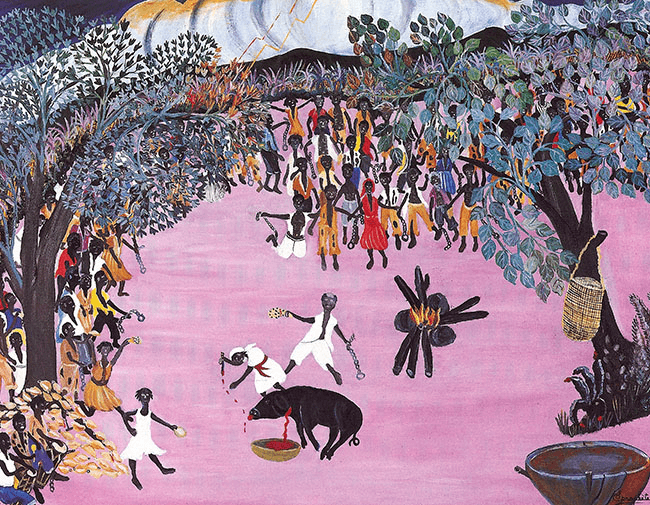
Painting of Bwa Kayiman Ceremony by Nicole Jean-Louis

What methodology did you use to pick the 12 principles that you chose? 

The methodology was largely observational. I did not immerse myself but observed, collected data and then went off to interpret these observations. That said, I am part of the peasantry myself and know their habits. When you ask them questions, they assess you and will give you an answer based on their assessment of you – what you look like to them. 

My interest peaked on the subject after hearing a person from the peasantry say, “Depi m gen manje pou m manje” – boiling life and necessities down to the issue of food which is all about survival. That means, a Haitian peasant is a person – and all of Haitian history supports this – who is prepared to live with the absolute minimum of what is vital for survival. We have to add to this minimum, because it cannot stay at the level of food. It has to be brought to the level of what a Haitian person needs to live. 

This distinction highlights a major difference between a capitalist society where people need to make money, and a society where people just want to make it through life with the minimum of what life has to offer them, without the need for accumulation. This was the first aspect of my work. 

From there we essentially discover that the philosophy of the peasantry should be associated with Bwa Kayiman because it can make the difference for us as a society, for us as an existence project if you will. 

Which principle do you think would be helpful to get the country out of this crisis?

Veye! Lènmi Bwa Kayiman ap vin sou tout kalite non, ak tout kalite rechany ... Watch out! The Bwa Kayiman’s enemies will come under all types of names, in all types of clothing...

12 Prensip Bwa Kayiman

Based on my experience, everyone who reads the principles, likes and integrates them, finds one principle that becomes fundamental to them. There are people who like the principle “Pa Lage Chay Nan Men Manfouben” and live by it. One ethnographer friend of mine told me he does not make any important decisions without consulting this principle. Another says “Chak Moun Gen Fason Pa Li Pou Li Lapriyè” led her to accept her calling as a manbo and now she is one of the most powerful manbos in the country. They speak to people based on their journey. 

Now if I were to choose which principles would help us out of this crisis, they would be the very first principle, ”Pa Gen Moun Pase Moun'' and the principle that goes with it “Si Gen Pou Youn Gen Pou De”. They are fundamental to Haitian life. And, all of the difficulties we live come out of the contradictions that exist with the ”Pa Gen Moun Pase Moun” principle and the apartheid society that emerged from colonization. 

To understand this apartheid society, we must square the principles of Bwa Kayiman with Article 59 of the 1685 Code noir. This article concerns the free blacks who began fighting to change the system before the revolt. They were fighting for their interest, so that they could have the same rights as the whites using Article 59. 

It was on the basis of this Article that they were fighting and it is with it that they were making their demands to the French. In that same article, they did not see the question of liberty for all. And that’s where Bwa Kayiman comes in. 

It offered liberty for all, and established the principle of ”Pa Gen Moun Pase Moun”. Meaning a white person cannot be superior to a black person. What makes you a person is what you have inside and what you contribute to life, not the color of your skin. These two principles are fundamental and you will find political organizations that have adopted these principles as slogans. Particularly the former. And with these principles we can build another society where we have a state that considers the needs of all citizens in the country, with respect for one another and in consideration of “Chak Moun Gen Fason Pa Li Pou Li Lapriyè”. 

12 Prensip Bwa Kayiman

  1. Tout moun se moun. Pa gen moun pase moun. All people are human. No person is better than another (or is more human than another).

  2. Tout moun gen plas yo anba syèl ble a. Everyone has their place under the blue sky.

  3. Si gen pou youn gen pou de. If there is enough for one, there is enough for two.

  4. Chak moun gen fason pa li pou li lapriyè. Respekte fason chak moun lapriyè… Everyone has their own way to pray. Respect how everyone prays.

  5. Sa nou pa konnen pi gran pase nou. What we do not know is greater than us.

  6. _Nan pwen anyen nan lavi a ki pa gen règleman. Se règleman ki bay lavi a ekilib._ There is nothing in life without a law. Law gives life balance.

  7. Pa defèt ekilib lavi a san rezon. Moun, ki mal deplase eleman yo, ap rale malè sou tout moun. Do not displace life's balance without reason.

  8. Tank n ap aprann, se tank n ap konnen kòman pou nou respekte ekilib lavi a. The more we learn, the more we will understand how to respect life's balance.

  9. Pa janm manje manje bliye. Never forget things easily.

  10. Toujou sonje: fè koupe fè; dèyè mòn gen mòn; pa fè san inosan koule; pa lage chay nan men manfouben. Always remember: no matter how tough you are, there is always someone tougher; there are more mountains behind mountains; do not shed the blood of innocents; do not have careless people bear responsibility.

  11. Veye! Lènmi Bwa Kayiman ap vin sou tout kalite non, ak tout kalite rechany pou yo tire revany. Watch out! The Bwa Kayiman’s enemies will come under all types of names, in all types of clothing for revenge.

  12. Malè yon eritye ki bliye esklav fè Bwa Kayiman pou moun k ap sèvi Bondye pa lote moun nan mitan bèt. Shame on the heir who forgets that slaves made Bwa Kayiman so that people who are serving God may may never again be put in packs among animals.

Featured Images: The Black Atlantic
Principle translations: Potomitan.info

Do you know the 12 principles of Bwa Kayiman? A conversation with Professor Pierre Michel Chery

"The 12 principles of Bwa Kayiman was an answer that came to me..."

Professor Pierre Michel Chery

The Bwa Kayiman ceremony that took place in the North of what is now Haiti on August 14, 1791 was a critical event in Haiti’s history. It was held by enslaved Haitians to launch the revolution against slavery and French colonialism, and consisted of a Vodou ceremony and a political meeting. We know that resistance against slavery happened consistently in the daily lives of our ancestors and a number of rebellions took place long before 1791. What sets Bwa Kayiman apart from other collective acts of resistance in Saint Dominique is that it was a planning meeting and religious ceremony that included a solemn vow by those who participated to be free or die fighting for it. Beyond its importance in terms of strategy, it’s one moment in Haitian history from which the collective Haitian imagination  to become a nation is drawn, and it is regularly referred to in times of political struggle in present day Haiti. 

Despite Bwa Kayiman’s importance in the creation of the Haitian nation, the date and the place have not been elevated by the Haitian state as an official holiday. In a recent lecture on how the Haitian state and civil society has built sites of heritage and collective memory around our history, Haitian Art historian Carlos Celius, described and analyzed that aspect of Haitian identity formulation. Celius explains that the Haitian state has promoted the importance of forts and commemorated dates of battles as national holidays. Bwa Kayiman is simply not elevated to the status of other historic symbols of our independence.  August 14th is not a national holiday and it remains a contested site because of its association with Vodou. 

Professor Pierre Michel Chery proposed the 12 Prensip Bwa Kayiman, a set of values associated with Bwa Kayiman. People who study Haiti often make reference to them, particularly the first one – Tout Moun Se Moun: Pa gen Moun pase Moun. We had a chance to talk to Professor Chery to understand where the principles come from. Below is a transcription of our conversation with him with some changes for clarity. 

Why did you propose the 12 principles of Bwa Kayiman?

The 12 principles of Bwa Kayiman was an answer that came to me in a sense. It came to me in a very particular context in the country in 2009. At the time there was a Protestant pastor who was undertaking a kwazad that centered on demonizing Bwa Kayiman and Cecil Fatima as Jezabel. The event was widely broadcasted by the media and he held it in a large open space with large screens outside so that even passersby could tune in.

What shocked me about this week-long kwazad was how the pastor treated someone like Cecil Fatima and Bwa Kayiman. Bwa Kayiman is a part of the founding of Haiti. I was shocked that no intellectual, not one ethnographer, nor anthropologist had responded to such a negative discourse on the very foundation of Haitian society. 

This indifference from the intellectual community was unacceptable. It felt like an interpellation. There is a saying that goes, if you notice that there's something to be done and there’s no one else to do it, you should do it yourself. 

From there, I had already been exploring subject matter pertaining to what makes the strength of the Haitian peasantry.  That same night, I drew from this work and was able to find the links between the life philosophies of the Haitian peasantry and the 12 principles of Bwa Kayiman. 

Painting of Bwa Kayiman Ceremony by Nicole Jean-Louis

What methodology did you use to pick the 12 principles that you chose? 

The methodology was largely observational. I did not immerse myself but observed, collected data and then went off to interpret these observations. That said, I am part of the peasantry myself and know their habits. When you ask them questions, they assess you and will give you an answer based on their assessment of you – what you look like to them. 

My interest peaked on the subject after hearing a person from the peasantry say, “Depi m gen manje pou m manje” – boiling life and necessities down to the issue of food which is all about survival. That means, a Haitian peasant is a person – and all of Haitian history supports this – who is prepared to live with the absolute minimum of what is vital for survival. We have to add to this minimum, because it cannot stay at the level of food. It has to be brought to the level of what a Haitian person needs to live. 

This distinction highlights a major difference between a capitalist society where people need to make money, and a society where people just want to make it through life with the minimum of what life has to offer them, without the need for accumulation. This was the first aspect of my work. 

From there we essentially discover that the philosophy of the peasantry should be associated with Bwa Kayiman because it can make the difference for us as a society, for us as an existence project if you will. 

Which principle do you think would be helpful to get the country out of this crisis?

Veye! Lènmi Bwa Kayiman ap vin sou tout kalite non, ak tout kalite rechany ... Watch out! The Bwa Kayiman’s enemies will come under all types of names, in all types of clothing...

12 Prensip Bwa Kayiman

Based on my experience, everyone who reads the principles, likes and integrates them, finds one principle that becomes fundamental to them. There are people who like the principle “Pa Lage Chay Nan Men Manfouben” and live by it. One ethnographer friend of mine told me he does not make any important decisions without consulting this principle. Another says “Chak Moun Gen Fason Pa Li Pou Li Lapriyè” led her to accept her calling as a manbo and now she is one of the most powerful manbos in the country. They speak to people based on their journey. 

Now if I were to choose which principles would help us out of this crisis, they would be the very first principle, ”Pa Gen Moun Pase Moun'' and the principle that goes with it “Si Gen Pou Youn Gen Pou De”. They are fundamental to Haitian life. And, all of the difficulties we live come out of the contradictions that exist with the ”Pa Gen Moun Pase Moun” principle and the apartheid society that emerged from colonization. 

To understand this apartheid society, we must square the principles of Bwa Kayiman with Article 59 of the 1685 Code noir. This article concerns the free blacks who began fighting to change the system before the revolt. They were fighting for their interest, so that they could have the same rights as the whites using Article 59. 

It was on the basis of this Article that they were fighting and it is with it that they were making their demands to the French. In that same article, they did not see the question of liberty for all. And that’s where Bwa Kayiman comes in. 

It offered liberty for all, and established the principle of ”Pa Gen Moun Pase Moun”. Meaning a white person cannot be superior to a black person. What makes you a person is what you have inside and what you contribute to life, not the color of your skin. These two principles are fundamental and you will find political organizations that have adopted these principles as slogans. Particularly the former. And with these principles we can build another society where we have a state that considers the needs of all citizens in the country, with respect for one another and in consideration of “Chak Moun Gen Fason Pa Li Pou Li Lapriyè”. 

12 Prensip Bwa Kayiman

  1. Tout moun se moun. Pa gen moun pase moun. All people are human. No person is better than another (or is more human than another).

  2. Tout moun gen plas yo anba syèl ble a. Everyone has their place under the blue sky.

  3. Si gen pou youn gen pou de. If there is enough for one, there is enough for two.

  4. Chak moun gen fason pa li pou li lapriyè. Respekte fason chak moun lapriyè… Everyone has their own way to pray. Respect how everyone prays.

  5. Sa nou pa konnen pi gran pase nou. What we do not know is greater than us.

  6. _Nan pwen anyen nan lavi a ki pa gen règleman. Se règleman ki bay lavi a ekilib._ There is nothing in life without a law. Law gives life balance.

  7. Pa defèt ekilib lavi a san rezon. Moun, ki mal deplase eleman yo, ap rale malè sou tout moun. Do not displace life's balance without reason.

  8. Tank n ap aprann, se tank n ap konnen kòman pou nou respekte ekilib lavi a. The more we learn, the more we will understand how to respect life's balance.

  9. Pa janm manje manje bliye. Never forget things easily.

  10. Toujou sonje: fè koupe fè; dèyè mòn gen mòn; pa fè san inosan koule; pa lage chay nan men manfouben. Always remember: no matter how tough you are, there is always someone tougher; there are more mountains behind mountains; do not shed the blood of innocents; do not have careless people bear responsibility.

  11. Veye! Lènmi Bwa Kayiman ap vin sou tout kalite non, ak tout kalite rechany pou yo tire revany. Watch out! The Bwa Kayiman’s enemies will come under all types of names, in all types of clothing for revenge.

  12. Malè yon eritye ki bliye esklav fè Bwa Kayiman pou moun k ap sèvi Bondye pa lote moun nan mitan bèt. Shame on the heir who forgets that slaves made Bwa Kayiman so that people who are serving God may may never again be put in packs among animals.

Featured Images: The Black Atlantic
Principle translations: Potomitan.info

What's next for filmmaker Etant Dupain?
The Fight For Haiti takes a deep dive into why the “international community” supports the corrupt politicians and business persons who stole the PetroCaribe money and the dream of millions. 

Etant Dupain

Etant Dupain's last documentary, Madan Sara, started off with a blog post he wrote and published right here on WoyMagazine.com. Since then, we have had the pleasure of seeing the idea come to life, celebrating the stories of these women, and shedding light on their desperate need for support and resources. Etant Dupain has now announced that he plans to release a new documentary. We had a chance to talk with him and find out what's in the pipeline for him and his team.

Etant Dupain and Madam Clotilde of the Madan Sara documentary

We fell in love with the beautiful women in the Madan Sara film. How are Madam Clotilde and Madam Monique doing since the release of the film? 

Madam Clotide and Madam Monique are doing ok. They’re well physically, but not morally. Their businesses have been crumbling because of the current political crisis in Haiti. Madan Sara is one of the groups affected the most by the systemic insecurity installed in the country by gangs with political ties. I made sure to stay in touch with them and some of their kids because we need to keep screening the film in Haiti and I would like for them to participate. One of the most successful screenings we had at the Université Quisqueya (UNIQ), was organized by Monique’s son who’s a student there. I am still planning on working with them to resume public screenings of Madan Sara as soon as we can. 

You’ve recently announced your new film The Fight For Haiti. The title makes me think of the women in the Madan Sara film and their struggle to make ends meet in the midst of political and economic violence. What is the connecting thread between Madan Sara and your upcoming documentary?

With The Fight For Haiti, I am hoping to add some context to the current crisis in Haiti. Haiti makes headlines for many things, but not for the fight for the soul of the country. I deeply believe the fight against corruption and impunity in Haiti is a fight for the soul of the country. This is not a simple fight. This is a fight where citizens are confronting a corrupt elite with no real international support or solidarity, while the corrupt elite has the full support of the so-called international community. 

Corruption is a major problem in Haiti.  It is unbelievable to watch how certain countries react to the anti-corruption movement. The Fight For Haiti takes a deep dive into why the “international community” supports the corrupt politicians and business persons who stole the PetroCaribe money and the dream of millions. 

I feel lucky to be able to tell our own story and show the world what’s really going on, instead of making headlines after major man-made disasters or natural ones. 

The common thread of your work is how it highlights the urgency for political action. What do you hope this next film will accomplish? 

The future of the anti-corruption and impunity movement hangs in the balance. Haitian politicians and the business elite with the total backing of the CORE group successfully dismantled the movement. With massacres, intimidation, and putting the whole country under siege and making it impossible to protest.

I hope to show the world the incredible sacrifice Haitians are making to fight for a better Haiti. I am hoping this film will give the movement some well-needed oxygen as Haiti is at a standstill. Millions of Haitians demand accountability and I don’t see a way forward without some form of accountability in the Petrocaribe scandal. A Petrocaribe trial can be a new beginning for Haiti.

I think the diaspora can play a bigger role in the fight against corruption and impunity, and I fully intend to use the film to mobilize more people in the diaspora to join the fight. 

What are some of the lessons you’ve learned while making your last film that you are bringing into this new project?

The first lesson I learned is to be patient.  It took me nearly five years to make Madan Sara. I want to take my time and tell this story well. For Madan Sara, no officials talked to me. I am facing the same situation, even worse with The Fight For Haiti. But my team and I will tell the story anyway. 

I learned how one story can impact major changes, both structurally and personally. I talked to the head of the Haitian Central Bank (BRH), Jean Badin Dubois, who told me his mom was a Madan Sara. We talked about Madan Sara and the lack of access to credit.  According to him, until recently most microfinance institutions in Haiti weren’t regulated. They gave out loans and set their own interest rates and ripped off people like the Madan Sara. BRH recently changed that and is currently implementing regulations to make sure microfinance institutions in Haiti follow all the rules and respect the interest rates set by the Central Bank. If well implemented this can be very useful for thousands of Madan Sara who rely on very expensive loans. 

On a personal level, I received countless emails and messages from Haitians all over the world talking about their parents. Some admitted they never knew about the Madan Sara as described in the film. For many, Madan Sara was a bad thing and some folks realized their parents were Madan Sara after watching the film. I am happy with the feedback and we’re just getting started as most people in Haiti haven’t had a chance to watch “Madan Sara”. 

Who are you collaborating with for this next project?

I am working with the same “Madan Sara” team.  Ou pa fè chanjman nan yon ekip k ap genyen. 

I am the Creator, Director, and Executive Producer on this project, but this project is here because of a great collaboration with matenmidiswa production, led by Haitian-Canadian artist, Manuel Mathieu. Wesley Lainé is one of our Co-Executive Producers and Lunise Cerin is our Editor. We have a great team and we have more people working with us. We won’t be able to name all of the names because of safety issues, especially for folks who reside in Haiti. 

The trailer will be out on August 14, the same date Gilbert Mirambeau Jr. posted the first #KotKòbPetroCaribeA tweet back in 2018. 

My team and I are hoping the trailer will add to the debate about the need for accountability.

What's next for filmmaker Etant Dupain?

The Fight For Haiti takes a deep dive into why the “international community” supports the corrupt politicians and business persons who stole the PetroCaribe money and the dream of millions. 

Etant Dupain

Etant Dupain's last documentary, Madan Sara, started off with a blog post he wrote and published right here on WoyMagazine.com. Since then, we have had the pleasure of seeing the idea come to life, celebrating the stories of these women, and shedding light on their desperate need for support and resources. Etant Dupain has now announced that he plans to release a new documentary. We had a chance to talk with him and find out what's in the pipeline for him and his team.

Etant Dupain and Madam Clotilde of the Madan Sara documentary

We fell in love with the beautiful women in the Madan Sara film. How are Madam Clotilde and Madam Monique doing since the release of the film? 

Madam Clotide and Madam Monique are doing ok. They’re well physically, but not morally. Their businesses have been crumbling because of the current political crisis in Haiti. Madan Sara is one of the groups affected the most by the systemic insecurity installed in the country by gangs with political ties. I made sure to stay in touch with them and some of their kids because we need to keep screening the film in Haiti and I would like for them to participate. One of the most successful screenings we had at the Université Quisqueya (UNIQ), was organized by Monique’s son who’s a student there. I am still planning on working with them to resume public screenings of Madan Sara as soon as we can. 

You’ve recently announced your new film The Fight For Haiti. The title makes me think of the women in the Madan Sara film and their struggle to make ends meet in the midst of political and economic violence. What is the connecting thread between Madan Sara and your upcoming documentary?

With The Fight For Haiti, I am hoping to add some context to the current crisis in Haiti. Haiti makes headlines for many things, but not for the fight for the soul of the country. I deeply believe the fight against corruption and impunity in Haiti is a fight for the soul of the country. This is not a simple fight. This is a fight where citizens are confronting a corrupt elite with no real international support or solidarity, while the corrupt elite has the full support of the so-called international community. 

Corruption is a major problem in Haiti.  It is unbelievable to watch how certain countries react to the anti-corruption movement. The Fight For Haiti takes a deep dive into why the “international community” supports the corrupt politicians and business persons who stole the PetroCaribe money and the dream of millions. 

I feel lucky to be able to tell our own story and show the world what’s really going on, instead of making headlines after major man-made disasters or natural ones. 

The common thread of your work is how it highlights the urgency for political action. What do you hope this next film will accomplish? 

The future of the anti-corruption and impunity movement hangs in the balance. Haitian politicians and the business elite with the total backing of the CORE group successfully dismantled the movement. With massacres, intimidation, and putting the whole country under siege and making it impossible to protest.

I hope to show the world the incredible sacrifice Haitians are making to fight for a better Haiti. I am hoping this film will give the movement some well-needed oxygen as Haiti is at a standstill. Millions of Haitians demand accountability and I don’t see a way forward without some form of accountability in the Petrocaribe scandal. A Petrocaribe trial can be a new beginning for Haiti.

I think the diaspora can play a bigger role in the fight against corruption and impunity, and I fully intend to use the film to mobilize more people in the diaspora to join the fight. 

What are some of the lessons you’ve learned while making your last film that you are bringing into this new project?

The first lesson I learned is to be patient.  It took me nearly five years to make Madan Sara. I want to take my time and tell this story well. For Madan Sara, no officials talked to me. I am facing the same situation, even worse with The Fight For Haiti. But my team and I will tell the story anyway. 

I learned how one story can impact major changes, both structurally and personally. I talked to the head of the Haitian Central Bank (BRH), Jean Badin Dubois, who told me his mom was a Madan Sara. We talked about Madan Sara and the lack of access to credit.  According to him, until recently most microfinance institutions in Haiti weren’t regulated. They gave out loans and set their own interest rates and ripped off people like the Madan Sara. BRH recently changed that and is currently implementing regulations to make sure microfinance institutions in Haiti follow all the rules and respect the interest rates set by the Central Bank. If well implemented this can be very useful for thousands of Madan Sara who rely on very expensive loans. 

On a personal level, I received countless emails and messages from Haitians all over the world talking about their parents. Some admitted they never knew about the Madan Sara as described in the film. For many, Madan Sara was a bad thing and some folks realized their parents were Madan Sara after watching the film. I am happy with the feedback and we’re just getting started as most people in Haiti haven’t had a chance to watch “Madan Sara”. 

Who are you collaborating with for this next project?

I am working with the same “Madan Sara” team.  Ou pa fè chanjman nan yon ekip k ap genyen. 

I am the Creator, Director, and Executive Producer on this project, but this project is here because of a great collaboration with matenmidiswa production, led by Haitian-Canadian artist, Manuel Mathieu. Wesley Lainé is one of our Co-Executive Producers and Lunise Cerin is our Editor. We have a great team and we have more people working with us. We won’t be able to name all of the names because of safety issues, especially for folks who reside in Haiti. 

The trailer will be out on August 14, the same date Gilbert Mirambeau Jr. posted the first #KotKòbPetroCaribeA tweet back in 2018. 

My team and I are hoping the trailer will add to the debate about the need for accountability.