
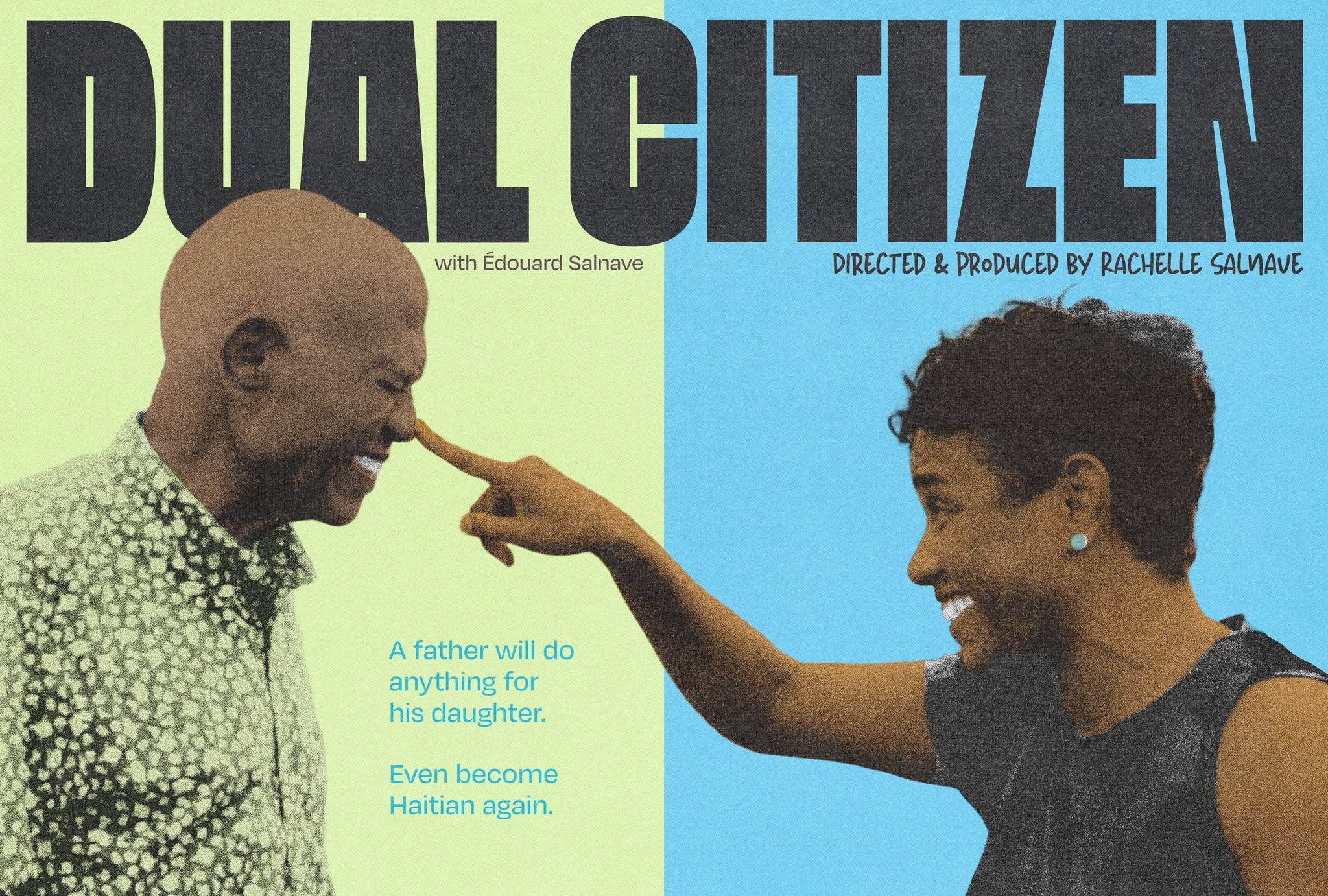

“Dual Citizenship” provides a history lesson on the Haiti of yesteryear, where anyone seeking freedom could arrive on Haitian shores and be deemed Haitian.
In “Dual Citizen,” a reluctant Haitian-born Edouard and his enthusiastic New York-born daughter, Rachelle, embark on a journey to obtain Haitian citizenship, which would make them citizens of both Haiti and the United States. At the heart of director Rachelle Salnave's latest documentary is attorney Genevieve Michel's question: "Why? Why are you doing this?" The answer is complex, as the film takes us through the winding roads of Port-au-Prince and the challenges the father-daughter duo faces in securing Haitian citizenship.
“Dual Citizen” provides a history lesson on the Haiti of yesteryear, where anyone seeking freedom could arrive on Haitian shores and be deemed Haitian. Things shifted with the Duvalier regime, specifically with the fall of Baby Doc. Suddenly, a new constitution banned dual citizenship. There were numerous efforts to pass an amendment to rectify this. None were successful until 2012, when a constitutional amendment granting citizenship to anyone born of Haitian parents was passed. The film reveals the many flaws in the amendment itself, in the other laws that interpret the constitution, and in the systems of people and places that enforce it all.
Much like Salnave's "La Belle Vie," "Dual Citizen" is a mostly cinéma vérité film peppered with interviews, a first-person documentary in which the filmmaker invites the audience to accompany her on a journey. That style allows for more intimacy and, at times, it feels like eavesdropping on conversations between Salnave and her father. It can also be limiting because it doesn't allow exploration of other people's experiences.
The film lays bare some of the realities of Haitian culture through the eyes of the filmmaker and her father. Privilege is a prominent theme. Be it the last name, the fair skin, or the relationships that allow direct contact with high-ranking government officials and attorneys, Salnave and her father have a clear advantage over the average Haitian-American navigating the system.
The film raises the question: what are Haitian politicians' motives behind enforcing this constitutional amendment? Perhaps it's a significant source of revenue, but the film leans toward their desire to court the diasporic vote.
There is also a fascinating legal discussion at the heart of the film about what it means to be a "Haïtien d'origine" and what rights come with that label: whether your grandparents must also be Haitian and whether you must not have ever renounced your citizenship. As someone whose birth certificate reads "PAYSAN ... Née à l'hôpital Justinien. Cap-Haïtien, Haïti," I watched with great intrigue the lengths the duo went through for something I take for granted.
The film's personal, first-person framework naturally calls for a richer exploration of the duo's relationship, and it ultimately suffers from the lack of that context. There are a couple of conversations that feel unfinished and leave us wondering. Throughout "Dual Citizenship," we see a tension between Edouard and Rachelle. There is resentment and strain between the two that the film only touches on at the surface. A deeper dive would have shed some light on what is really driving Edouard, a Trump supporter, to be reluctant but still willing to make this journey to please his daughter, and Rachelle to be so enthusiastic about the sheer possibility of being Haitian on paper, though she already is in almost all other aspects of her life.
Which brings us to the why. Why go through such great lengths for dual citizenship? Is it to have the right to vote in elections in a country where you don't reside and perhaps don't grasp the everyday realities of those living there? Is it to feel a stronger connection to the land? Is it simply to test the system? Perhaps the answer lies in the film's closing minutes, but what is clear is that Edouard and Rachelle have a deep and abiding love for Haiti. Ultimately, "Dual Citizenship" is more about the journey than the destination. It's more about family than politics. It's about Edouard and Rachelle challenging each other and reaffirming their Haïtienneté.
ABOUT THE RACHELLE SALNAVE
Rachelle Salnave is a filmmaker and cultural leader whose work explores migration, Haitian identity, and Black global life across the Americas. Her Emmy-nominated documentary La Belle Vie: The Good Life earned national recognition in 2016, and in 2017 she was named a Knight Arts Champion by the Knight Foundation. A 2015 Sundance Institute Screenwriters Intensive Fellow, Salnave’s work spans independent film and public media. Madame Pipi is part of PBS’s REEL South series, while ART: By Any Means Necessary is featured on PBS’s Art Loft. Dual Citizen, her eighth film project and third feature documentary, is currently touring internationally. Salnave is based between Jacmel, Haiti, and Miami.
ABOUT MARTINE JEAN
Martine Jean is a Haitian-American attorney turned filmmaker based in Los Angeles, CA.


" height="102.5816409423233px" id="g2kZUfxvI" width="102.91800162469531px"/></svg>)
" height="103px" id="oG538LvCh" width="102.99817255782794px"/></svg>)
" height="103px" id="SKAc1JCfN" transform="translate(1.11 0)" width="100.78524425744274px"/></svg>)