

As Haitian diaspora communities across the United States cheer on Haiti's historic participation in the 2026 FIFA World Cup, many fans who would have traveled from Haiti to support their team were denied visas or could not afford the trip. The celebration unfolds against a backdrop of uncertainty: many of the people waving Haitian flags in American stadiums are fighting to remain in the country that is hosting the games.
“The fear in Haiti is not of zombies, but rather of becoming a Zombie”
Haitian migrants are trapped. The tightening of the United States' neocolonial grip, both in Haiti and at its borders, has robbed Haitian migrants of their freedom to move and exist safely. A web of shifting immigration policies has dehumanized Haitian migrants, birthing the "immigrant crisis narrative" that shapes public perception today. Suspending thousands in liminal uncertainty, cruel and ambiguous immigration policy resembles a form of zombification, condemning Haitians to exist between belonging and expulsion, unable to move forward or go back.
A phenomenon transported from the lands of the Kongo in West Africa to the sugar plantations of Saint Domingue, the nzambi (soul), later known as the zonbi in Kreyòl, was birthed out of Haitian folklore and Vodou before being bastardized by Western media. Haitian Vodou acknowledges death as a transition to a different realm, not an absolute end. Death was desired by enslaved Haitians who were brutalized under French colonial rule. It meant that their souls would return to Ginen (Guinea, Africa) for eternal freedom.
The zonbi, however, is trapped in the in between. In Vodou, the soul is split into two: ti bon ange and gros bon ange, the former being the soul that gives the body willpower, memory, and awareness, and the latter governing the body's motor functions and mind. The person who has ordered the act of zombification injects a poison, robbing the person of their ti bon ange and condemning the zonbi to an afterlife of slavery instead of the freedom they yearned for — suspended, neither dead nor free, between worlds.
That liminal suspension echoes across centuries. Haitians have been fleeing in droves to escape the ills of imperialism and poverty, taking to the waters in search of lavi miyò, a better life, and eternal freedom. Haitians were the test pilot for US maritime migrant interventions and enforcements, a demonstration of empire's long, colonial and neocolonial histories of ravaging waters, exploiting it as a liquid border. Water serves as a liminal space where Haitians are transported through a threshold of existence, between unconsciousness and consciousness. But increasingly cruel and violent border practices have transformed those waters into a space of violence against Haitian bodies, following in the traditions of colonialism's violence throughout the Atlantic. The salty waters retain their memories. Safeguarded by the Ginen, the spiritual underworld beneath the waves, the zonbi coexist in a state of liminality and in acts of resistance until they can reunite with their ti bon ange.
Temporary Protected Status (TPS) allows people from select countries who are facing natural disasters, war or conflict, or other unsafe conditions to live and work legally in the United States for 18-month periods, and can be renewed if those designated countries remain unsafe to return to. President Trump and his administration have been aggressive in their approach to remove protections for Haitians by pausing the review process for pending applications for green cards, citizenship or asylum. While Haitians have been given some breathing room as a D.C. judge ruled in favor of pausing the TPS termination on February 2nd, 2026, the Trump administration is adamant to continue challenging the pause under the guise of protecting U.S. national interests by taking their arguments to the Supreme Court in April. The uncertain future of Haiti’s TPS designation makes it increasingly fearful for Haitian immigrants to remain active in their communities. For the hundreds of thousands living under that uncertainty, this policy governs every major decision of their lives.
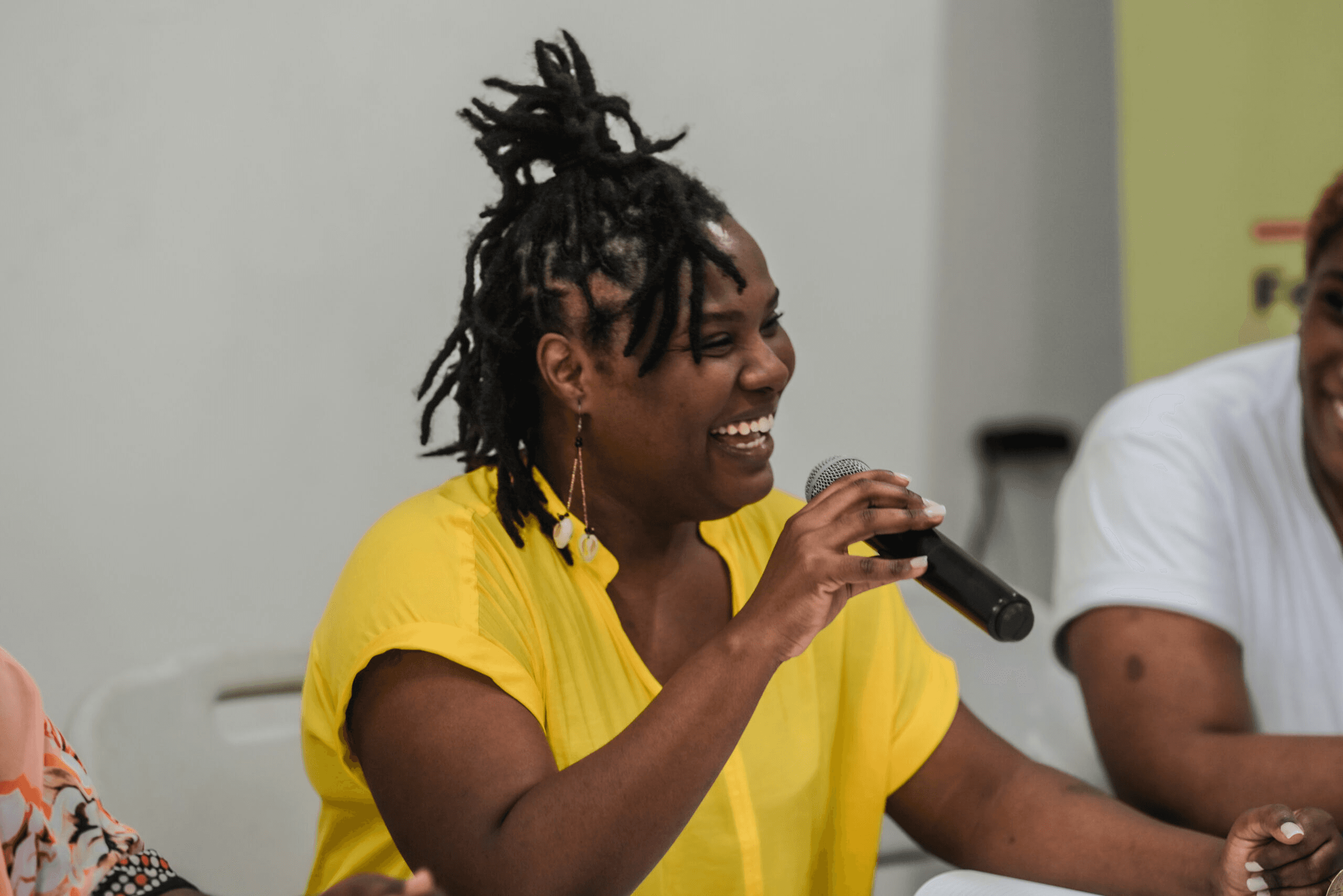
Evelyne*, (a pseudonym) is a 33-year-old Haitian woman living in New York City. Evelyne works in public health and is one of the 350,000 Haitians across the country who straddle the line of documented and undocumented status because of the federal administration’s mission to terminate Temporary Protected Status. “I feel trapped in every single way. You never feel like you have a home because at any point, they can completely uproot your life because your status is not stable,” she said.
The dehumanization of Haitian migrants is the foundation for many US border control practices. Almost 50 years ago, the Carter administration’s “Haiti Program” fast-tracked Haitians for deportation without fair treatment in the judicial system or adequate translators. Reagan’s detention policies to intercept Haitian migrants at sea before reaching US borders soon followed and gave way to both George H.W. Bush and Clinton administrations’ cruel detention of HIV-positive and HIV negative Haitian asylum seekers at Guantanamo Bay.
Tragic scenes from under a bridge in Texas, where hundreds of Haitian migrants had taken shelter, took the media by storm in 2021. Lack of food, water, and medical care were common violations at the makeshift camps in Del Rio, Texas, where the infamous image of Mirard Joseph trying to escape a border patrol on horseback came to symbolize the conditions of anti-Haitianism in America. President Trump referring to Haiti as a “shithole country” or escalating hysteria by claiming Haitian migrants “eat cats and dogs” contributes to a decades-long, public health stigmatization of Haitian bodies as undesirable to justify surveillance, containment, and expulsion.
Described as the “longest neocolonial experience in the world” by Professor Jemima Pierre, the ongoing military occupation after the 2004 coup against President Jean-Bertrand Aristide triggered the modern-day zombification process. American political interference with the election of Michel Martelly and the creation of an unelected government and cabinet of officials after the 2021 assassination of Jovenel Moise have deepened the instability of the island, challenging the independence of the Haitian people and their will to self-govern. Natural disasters and U.S. relief programs have developed Haiti into an “aid state,” and cholera, introduced by UN peacekeepers, weakened an already fragile infrastructure. Rampant gender-based and gang violence, economic and food insecurity, have pushed the Haitian people far outside of their limits of survival, forcing them to flee conditions that the US government and the CORE group are responsible for creating and sustaining.
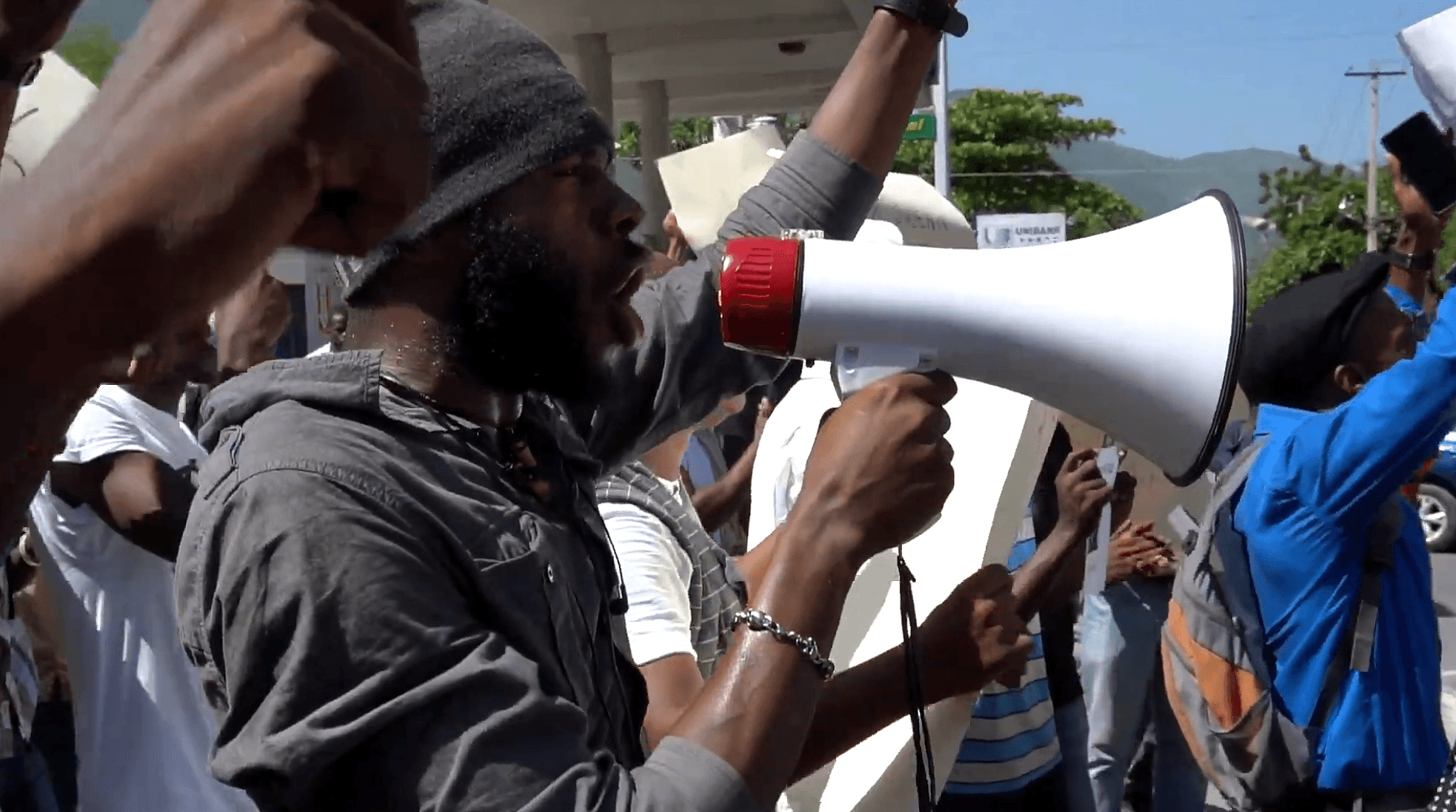
On April 29, the Supreme Court heard oral arguments on the future of TPS for Haiti. Outside, a passionate crowd of organizations, activists, and community members gathered, chanting and waving flags in defense of their safety and their right to remain. Among them was Marie, representing Haitian Women for Haitian Refugees. A feminist activist with the organization KOFAVIV in Haiti for years, Marie was eventually forced to flee for her life and now lives in the United States under TPS. "TPS la se bra dwat nou... TPS is our right arm," she says. “It is what allows us to struggle, work, and take care of our family.” Standing before the steps of the Supreme Court, with police agents stationed behind the stage and at the ready, Marie sang a song to Nago, a family of lwas represented by fighter spirits of war and fire, asking for strength for the fight ahead. “The song I sang was a song of the revolution because our ancestors fought with the spirits of Nago alongside them. Papa Dessalines himself, the emperor, fought to the rhythm of Vodou.”

Evelyne reflects on what she wants for her life long-term, “I want to have kids, but I wouldn’t want to have kids with this status. What if I get arrested or deported? I lose opportunities at work because if there is a conference abroad, I cannot take that risk of not being able to get back into this country. Even as I advance my career, it’s safer to stay in one job. Trying to find a job where I have to explain my work authorization is hard to navigate with employers. You feel like you must stay in one place, so you don’t have to keep addressing it.”
Returning to Haiti while it is currently on a travel ban list due to ongoing gang violence, kidnappings, and unrest is a dangerous risk for many Haitians. Ending TPS, along with the family reunification program and CHNV, leaves Haitian migrants in limbo.
Now that the United States has successfully injected its poison into the Haitian mainland through decades of political meddling, the poison travels with the migrants as they make their way to the United States. Once Haitian migrants arrive, they are oftentimes subjected to low wages, intensive labor, and no true path to citizenship, strengthening the zombification process. The Supreme Court will come to a decision by early July. In the meantime, hundreds of thousands of people are left waiting, their lives and futures hanging in the balance before a court packed with justices dedicated to this administration’s political project.
Frustrated, Evelyne continued, “ I can’t go back to Haiti, where I was born, and where I don’t know anyone, and wouldn’t know where to live. I can’t stay here because this country is blocking every single pathway to getting any type of residency here, and I can’t go to any other country while TPS is getting terminated here because I can’t prove any legal status. It’s really exhausting and overwhelming… It’s almost like they don’t want you to exist.”
Zonbi goute sel li pa mande rete (a zombie who tastes salt will not ask to stay) – Haitian Proverb
According to Haitian legend, “when a zombie tastes salt, he becomes aware of his condition and rebels against it. So salt is awareness…” The sugar plantations of Saint Domingue had subjected Haitians to inhumane conditions, offsetting centuries of exploitation. So, the cure could only be found in sugar’s opposition, salt. What taste of salt would be needed to reverse the slave's compliance and obedience to the master, reverse zombification, and restore their ti bon ange back to full humanity? Self-determination for the Haitian people and a fully liberated sovereign Haiti will sever the ties completely, so the risk of zombification can never happen again.


" height="102.5816409423233px" id="g2kZUfxvI" width="102.91800162469531px"/></svg>)
" height="103px" id="oG538LvCh" width="102.99817255782794px"/></svg>)
" height="103px" id="SKAc1JCfN" transform="translate(1.11 0)" width="100.78524425744274px"/></svg>)