
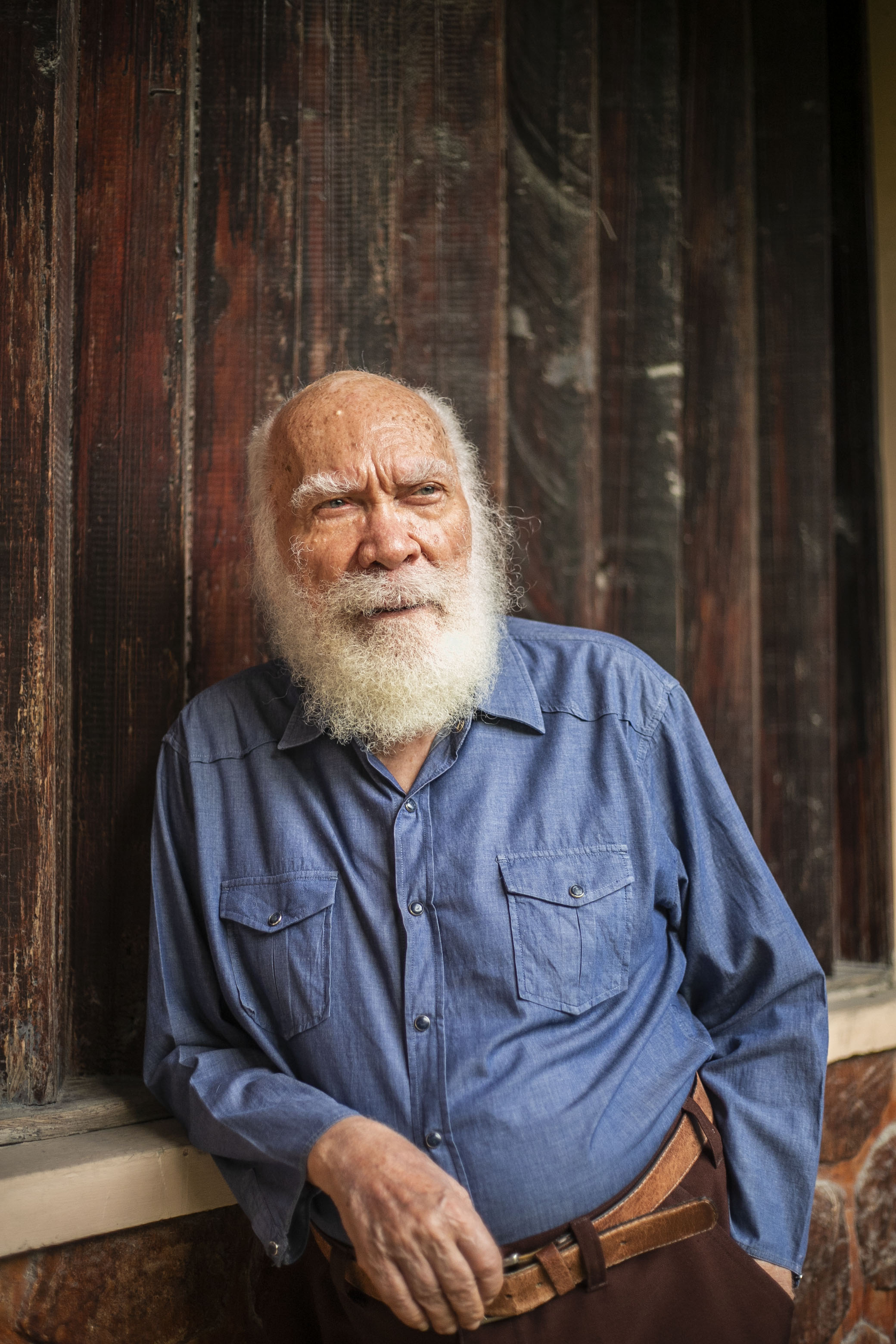

As we enter the third month of 2026, this reflection comes from a moment of constant loss in Port-au-Prince that has yet to release us. May we never cease to eulogize Frankétienne.
There is no city that is not also a text.
As the year 2025 unfolded, the constant tragic news from Port-au-Prince, a city now unrecognizable to itself, flowed freely. Against the backdrop of this turbulence, we in the Haitian literary community were preparing to commemorate the 30th anniversary of the death of René Philoctète, who is, uncontestedly, along with Georges Castera, one of the greatest Haitian poets to ever live. Our plans for the commemoration moved along smoothly, our work colored and fueled by passionate conversations about dictatorship, about violence, about hope, and about the new world we could imagine and build. Everything was there, ready to salute the immense brilliance that was Philoctète—or so we thought.
And yet, death. The sad companion that constantly looms over our lives and our cities reared its head. This time, it was neither the thousands of children murdered by armed groups, nor the desperate mothers searching the streets of a city that no longer exists for their sons. This time, amid the chaos of life, it was the brilliant virtuoso, Frankétienne.
He was born in 1936 in Grand-Gosier, in the Artibonite region, and raised in Port-au-Prince's Bel-Air neighborhood. From Port-au-Prince and Bel-Air in particular, the city would remain at the center of his imagination. He was born two years after the bloody fifteen-year U.S. occupation of Haiti, a period of political crisis, repression, and increasing poverty, under the troubled regime of President Sténio Vincent. He would later spend the first few decades of his adulthood under the Duvalier dictatorship, which famously persecuted so many writers.
His mother was a domestic worker for a white man who sexually assaulted her; Frankétienne was born a mulatto in the truest sense of the word. The popular saying, “Latibonit is a river that flows through one’s mother but not through one’s father,” would shape his convictions as a man and a citizen. He was not a man of greed, nor an opportunist who, like thousands of mixed-race Haitians before him, could have used his light skin to exploit and climb the social ladder. He refused to give himself a German or American name. And he refused to construct a bourgeois narrative of himself. Frankétienne’s political commitments were explicit, including his alignment with communist politics and leftist movements in Haiti.
Haitian writer Lyonel Trouillot, who had the honor of knowing Frankétienne, testifies: “Franck is the incredible sum of contradictions brought together in one body and one personal history: white–black; mulatto–black; city–countryside; rural popular culture–urban scholarly culture; urban popular culture–urban scholarly culture; attachment to left-wing social theories–spiritualism tinged with mysticism; Christian symbolism—Vodou symbolism… Franck fought his entire life to avoid being reduced to one of the poles of this flow of contradictions.”
These conflicts of identity are the product of social dynamics, of resistance to rotten prejudices, and of a dominant class that forged its culture through exclusion, racism, and radical contempt for Haitian people and their culture.
Frankétienne’s career began in 1961, four years after Duvalier seized power. At twenty-five, he published a collection of poems entitled Haiti, Haiti!. The works that would make him a legend would come later, but the style that made that possible was already present: a lyrical and committed tone, poetic force, and a spirit of protest.
His mother named him Jean Pierre Basilic Dantor Frankétienne D’Argent. In his first publication, he called himself Frank Etienne, two names that would merge into one around the 1970s, reflecting his artistic autonomy, his mystical roots, and his status as an unclassifiable artist with multiple identities.
“My grandmother Anne Etienne and my mother Annette Etienne decided to give me a rosary of valiant names, with mystical and baroque resonance, likely to protect the little ‘petit blanc’ against the mischief and evil spells of any sorcerers. This was easy for them to do, simply because they had no one to answer to, as my biological father, Benjamin Lyles, an American billionaire, never took responsibility for me. To avoid the malicious mockery I received from my classmates, my mother decided to consult a registrar to shorten my excessively long nominal identification. And so, at the age of seventeen, I became simply Franck Étienne. When I officially entered the field of artistic and literary creation, I became Frankétienne in one fell swoop. Much later, I discovered that ‘Frankétienne’ sounded bizarrely like ‘Frankenstein.’ A peculiar mystery linked to the Spiral and the unsettling nature of my work.” Frankétienne, for the UNESCO Courier.
There is no city that is not also a text. Walter Benjamin was right. Frankétienne dedicated his entire life to creating a body of work devoted to the places of his childhood, his escapades, and his loves. From his earliest writings, Port-au-Prince becomes a character, a poetic subject, a symbolic and intimate territory. The poet inhabits it and imbues his poetry with its essence.
Je suis de Port-au-Prince
Je conjugue mes cauchemars
Et je module mon insomnie à ma façon.
Ma ville en moi. Au fond de moi.
Dans ma tête et dans mes tripes.
I am from Port-au-Prince.
I conjugate my nightmares
and I manage my insomnia in my own way.
My city is within me. Deep inside me.
In my head and in my gut.
Together with writers René Philoctète and Jean-Claude Fignolé, Frankétienne co-founded Spiralism, a literary movement born in Haiti that rejected linear narrative in favor of contradiction and rupture. “To write is to dance with the lwa of language,” he once said.
Frankétienne’s work in the Kreyòl language is unmatched. Author of the first novel to be written and published entirely in Kreyòl, he produced with the language what few have managed to achieve: the construction of an autonomous and incisive poetic form that neither mimics proverbs, nor imitates the rhythm of any preexisting great poets, nor symbolizes in ways already charted. Nothing exemplifies this better than his poem Rapjazz, where Frankétienne describes his city as a love that has both made and unmade him.
Mwen deja di
Potoprens tchaktchak myakmayak
Potoprens doukla madjaka
Potoprens elastik sou balansin
Potoprens deboundare dechepiye.
I’ve said it before
Port-au-Prince tchaktchak myakmayak
Port-au-Prince doukla madjaka
Port-au-Prince elastic on a swing
Port-au-Prince broken and tattered.
Frankétienne's death marks both a beginning and an end: the beginning of a writing style that broke all established codes and norms, making him the most innovative Haitian writer of his generation, and the end of a movement that dies with him. In an era when literary legitimation is steeped in contempt for nondominant traditions, racism, and colonialism, Frankétienne stands as one of the few Caribbean writers to have reportedly been nominated for the Nobel Prize in Literature, drawing on Haiti and the Caribbean as his primary sources of legitimacy.
Bel-Air, the neighborhood that shaped Frankétienne's imagination and never left his work, has in recent years become one of the most violently contested areas of Port-au-Prince. As armed groups expanded their control across the capital, today holding, by some estimates, close to 90% of it. Bel-Air's residents have faced waves of displacement, burned houses, and streets emptied by force. Frankétienne spent his final years in Delmas, in precarious conditions, his beloved city unrecognizable and unreachable to him."
Frankétienne’s stance, creating a body of work centered on Haiti as a place of production and legitimation, is emphatically political, breaking away from the notion that literature is universal while quietly adhering to a universality defined by only a small part of the world.
So much can be said about Frankétienne. Paying tribute to him undoubtedly means intentionally engaging with his work and life. We must respect his contradictions and salute both his commitment and the rigor of his work.
In an era in which symbols are constructed through nostalgia and reactionary values, it is wise to recall truth and justice. The truth: that of a man who, because of criminal governments and repressive policies carried out in this country, was left heartbroken and deprived of his beloved city, of his Bel-Air.
What would a proper celebration of life for Frankétienne in Bel-Air have been like? I imagine him becoming a spirit of wind and time, setting the rhythm for voices and dances with his Simidor-like strength. I imagine him wandering through Bel-Air, playing the role of a maker of promises and dreams. Alas, Bel-Air is no more, and neither is Frankétienne. Playwright, novelist, poet, painter, Frankétienne was all of these things. A child, an eternal drummer, a striker in his city, Frankétienne remains all of these things.
For the writers of my generation, Frankétienne embodied the idea of a work that opens the way to a radically non-conformist literary space: no code, no school. The artist, by inventing himself, reinvents the aesthetic form itself. This, to me, is the beautiful lesson of Frankétienne. Art is the infinite space of possibilities. Chapo.

" height="102.5816409423233px" id="g2kZUfxvI" width="102.91800162469531px"/></svg>)
" height="103px" id="oG538LvCh" width="102.99817255782794px"/></svg>)
" height="103px" id="SKAc1JCfN" transform="translate(1.11 0)" width="100.78524425744274px"/></svg>)